
Polyimide Labels Explained: Material, Kapton and Print Compatibility
Request a solution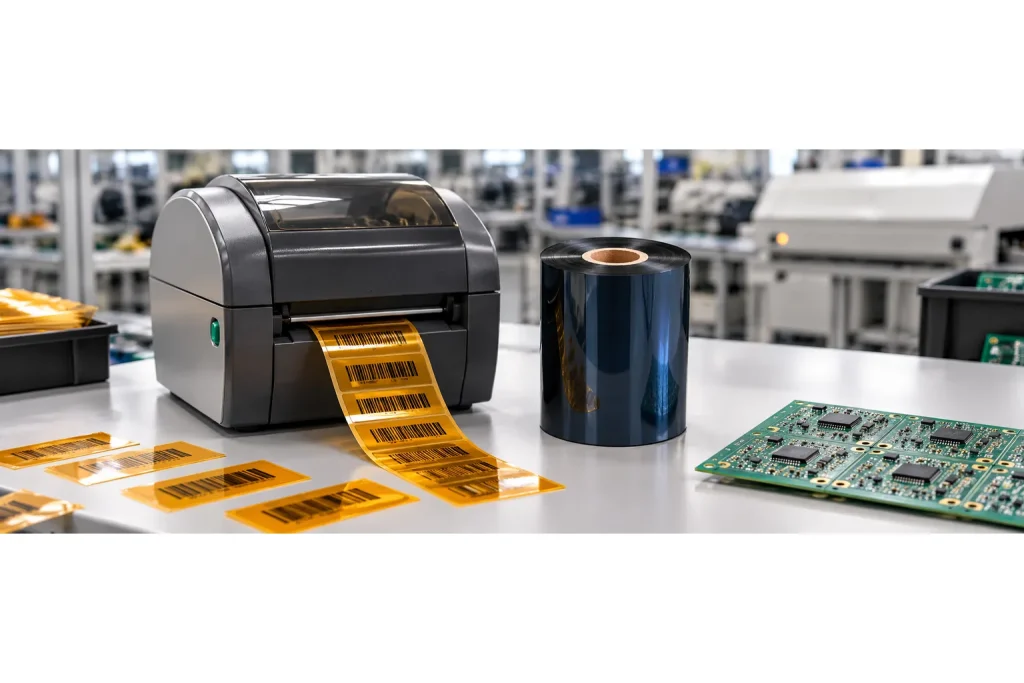
- Original TTR manufacturer since 2013
- Automated coating and slitting
- IQC / IPQC / OQC control
- ANSI barcode grade testing
- -20°C to 120°C environmental testing
- Batch-level traceability
- ANSI barcode grade
- Batch traceability
- RoHS / REACH compliance
- SGS and MSDS documents on request
For buyers printing industrial identification in-house, a polyimide label identifies a film-based material family associated with thermal stability and chemical resistance. Kapton names a branded polyimide film rather than a separate generic material. Confirm the complete label construction, printable surface and documented exposure conditions before treating the name as evidence of printing compatibility or service performance.
Key Takeaways
- Polyimide labels use a thin, flexible film with thermal stability and chemical resistance.
- Kapton is a DuPont brand name for polyimide film, although label descriptions often use the two terms interchangeably.
- The film, printable topcoat and adhesive answer different questions about a finished label.
- Full resin ribbons are generally suited to demanding synthetic films including polyimide; that category guidance does not qualify every combination.
What a polyimide label name actually identifies
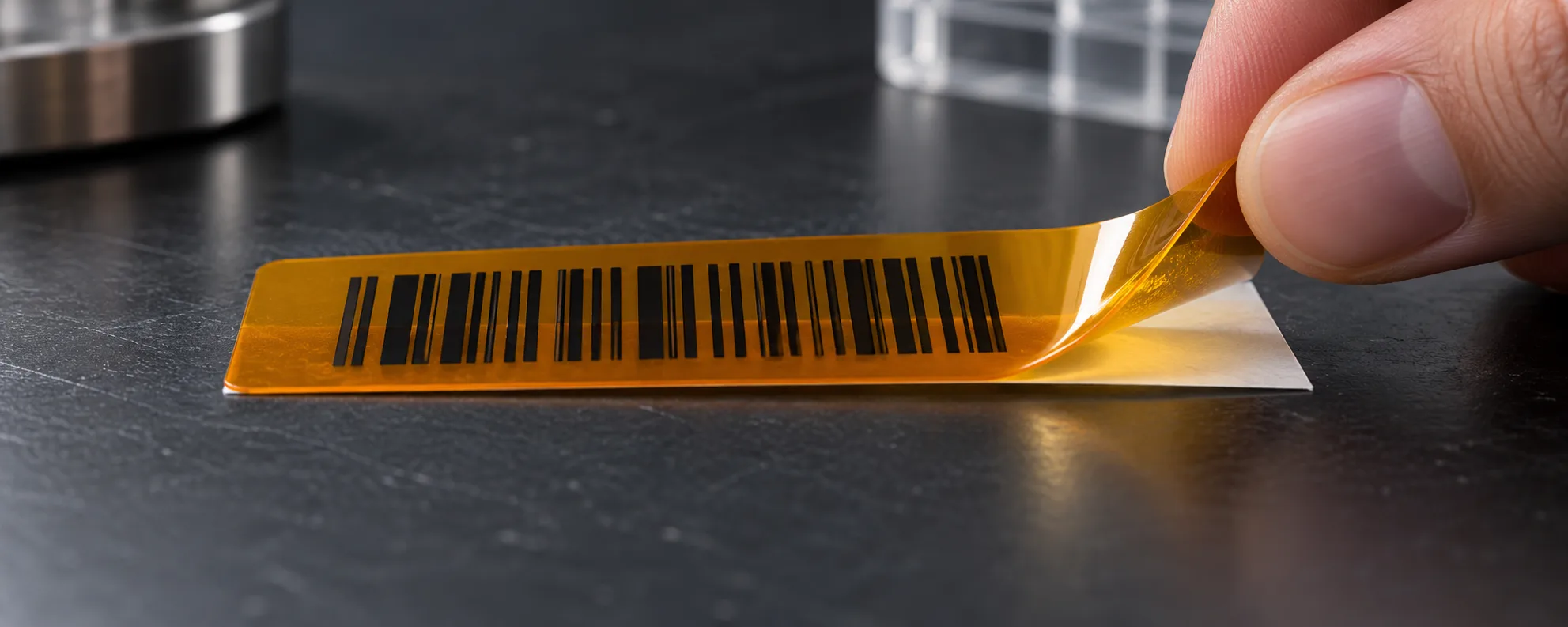
A polyimide label uses a thin, flexible polyimide film with strong thermal stability and chemical resistance. The name describes the film material; it does not provide a complete specification for the label you will print and apply. For a technical buyer, the useful distinction is between identifying that material family and approving a particular finished construction.
The supplied construction descriptions separate a core film, a printable topcoat and a pressure-sensitive adhesive. The film forms the substrate, the topcoat provides the printing surface, and the adhesive provides the bond. The adhesive description lists silicone- or acrylic-based options for high-temperature bonding. Those options are examples, so ask which adhesive the offered stock actually uses.
This explains why a material description can sound relevant while leaving practical questions unanswered. A statement about the film is not automatically a statement about the ink image or the adhesive bond. When comparing suppliers, request the construction reference alongside the material name so that your comparison concerns identifiable stock.
For example, if two quotations both say “polyimide label,” ask each supplier to identify its film, topcoat and adhesive. This is a request for the missing specification, not a reason to assume the products differ or match. Keep the material description and the approval decision separate until the supporting details are available.
How polyimide differs from Kapton, PET and vinyl
Kapton is a brand name for polyimide film manufactured by DuPont. In everyday label descriptions, “Kapton labels” and “polyimide labels” are often used interchangeably. That usage explains the overlapping names, but it does not establish that every generic polyimide offer uses branded Kapton film.
If a drawing or customer specification explicitly requests Kapton, ask for confirmation of the film identity. If the requirement simply says polyimide, avoid adding a brand requirement without checking why it is needed. The distinction lets you discuss the specified material accurately without treating a familiar trade name as proof of the whole label’s performance.
PET and vinyl are adjacent label-material choices, rather than alternative names for polyimide. The supplied comparison describes polyimide for the highest continuous-heat demands within that comparison, matte silver PET for durability with print contrast, and vinyl for curved or irregular surfaces. It also states that these materials are not interchangeable merely because they appear within a UL969 label-material range.
Use those differences to frame the requirement, rather than rank every application by one property. Ask whether the job is primarily about thermal exposure, print contrast or surface shape. Then obtain the exact candidate’s specification. The broad comparison does not supply a shared operating temperature, chemical test result or permission to substitute one material for another on an approved drawing.
Where heat resistance and printing compatibility come from
The supplied polyimide construction evidence describes labels that maintain barcode legibility and adhesion through wave soldering, reflow ovens and other thermal processes. It attributes that behavior to a multilayer construction. This supports considering such constructions for those processes; it does not give every product carrying the material name an identical process rating.
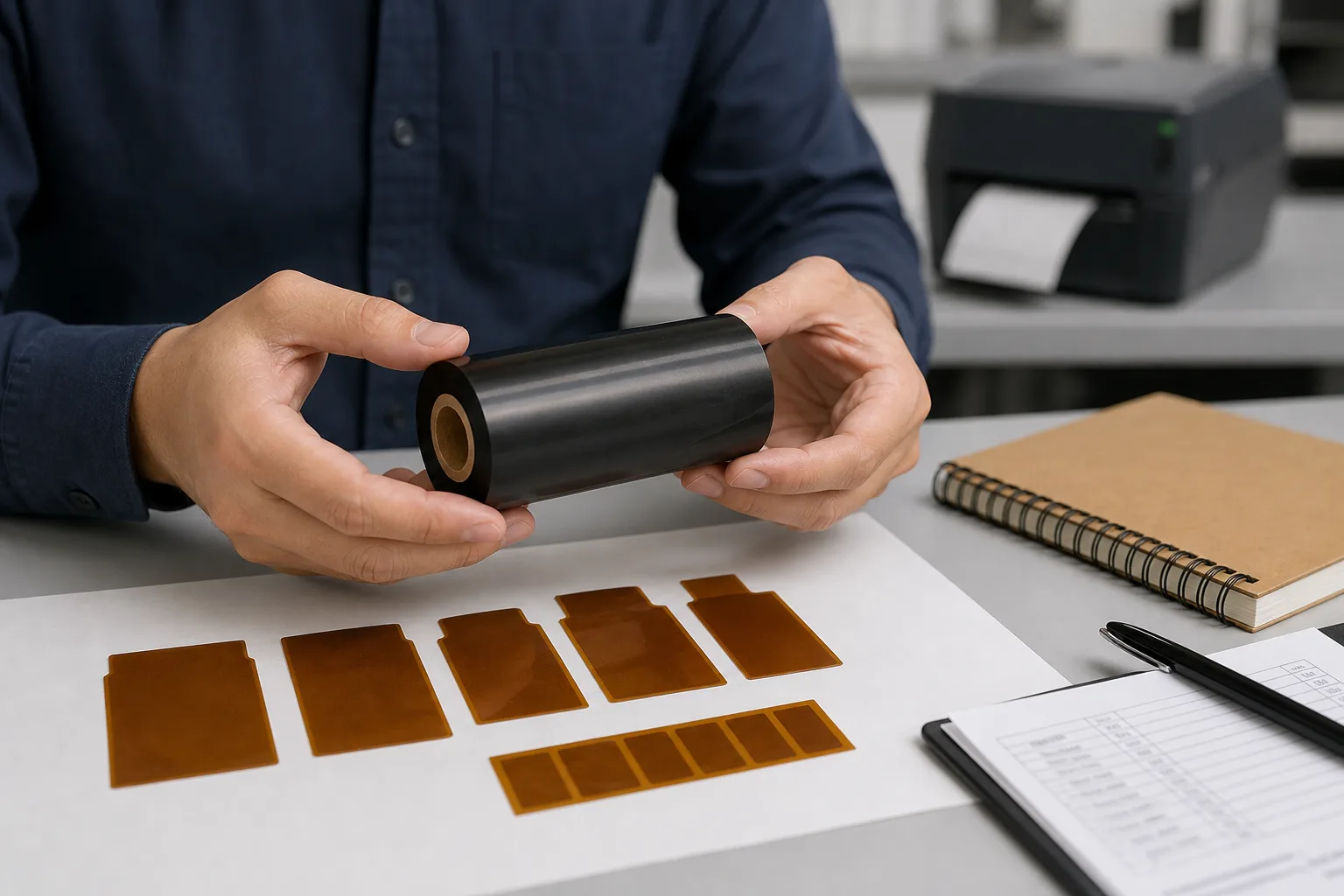
For in-house thermal transfer printing, full resin ribbon is the supported starting category for demanding synthetic films such as polyimide. The evidence contrasts that category with wax for porous and coated paper, and wax resin for coated paper and selected synthetics. A ribbon family is therefore a useful first filter, rather than the final answer for an unidentified label surface.
The printable topcoat also matters when interpreting the printing method. The supplied description refers to topcoats accepting thermal transfer, laser or inkjet printing. Ask which method the specific stock is intended to accept; do not read that list as confirmation that one roll accepts all three methods.
Before choosing a ribbon for a sample trial, give the supplier the exact label reference and printer identification. Request a recommendation for that combination and retain the ribbon grade with the trial record. Treat a readable fresh print as an initial observation, then assess the image and bond under the intended conditions. This keeps the decision tied to your own printing process rather than a generic material description.
Data and Evidence
The supplied evidence supports material-family distinctions and construction-based evaluation, but it provides no universal finished-label temperature limit. The table separates what can be concluded now from the information needed for a specific approval.
| Evidence topic | Supported conclusion | What to verify for your application |
|---|---|---|
| Film properties | Polyimide film is thin and flexible, with thermal stability and chemical resistance. | Exact stock reference and documented exposure conditions. |
| Brand identity | Kapton is DuPont’s polyimide film brand. | Whether the offered film has the brand identity required by your specification. |
| Printing | Full resin ribbons are generally suited to polyimide and other demanding synthetic films. | Printable topcoat, ribbon grade and printer combination. |
| Adhesion | Temperature cycling, chemical contact and surface energy affect adhesion. | Samples with the same material stack applied to the same surface. |
| UL969 documentation | The supplied description concerns facestock, adhesive and print system recognition under a valid PGDQ2 file. | Documentation covering the proposed construction and print system. |
Source basis: the supplied references titled “Polyimide labels,” “Kapton,” “Printable topcoat,” “Pressure-sensitive adhesive,” “Wax ribbons,” “adhesion” and “UL969 label.” These support the distinctions above, rather than a numerical performance promise for an unspecified roll.
For a supplier change, use the following evidence sequence:
- Record the existing and proposed construction references, including the printing surface and adhesive.
- Request the proposed stock’s documented conditions for the heat and chemical contact relevant to your process.
- Print samples using the proposed ribbon and your intended printer, and retain the combination details.
- Apply samples to the intended surface and evaluate adhesion and legibility through the relevant process before approval.
If documentation or samples leave a requirement unresolved, record that specific gap rather than approve from the word “polyimide.” Your next step is to obtain a construction-specific specification and sample set for the process you actually need to run.
Frequently Asked Questions
Does a Kapton label always mean the same thing as a polyimide label?
Kapton is DuPont’s brand name for polyimide film. The terms are often used interchangeably, but a generic polyimide description does not establish the film’s brand or the finished label construction.
Can I choose a thermal transfer ribbon from the polyimide label name alone?
No. Full resin ribbons are a supported starting category for polyimide films, but the printable surface, ribbon grade and printer combination still need confirmation and a sample trial.
Does a polyimide label name provide a maximum operating temperature?
The material name alone does not establish a finished label’s temperature limit. Request the exact construction’s specification with exposure conditions before approving it for your process.
Does specifying polyimide establish UL969 acceptance?
No. The supplied UL969 evidence concerns the facestock, adhesive and print system under a valid PGDQ2 file. Ask for documentation covering the proposed construction.
Recommended products for this industry

CL-581 Polyimide Label Material for PCB Process Tracking
A white gloss polyimide (PI) label material with a listed thickness of 1mil and an acrylic adhesive, intended for printed circuit board (PCB) and sensitive-component process control and product traceability in electronics manufacturing. The product description includes wave soldering and reflow soldering applications. Selection requires checking the actual heat exposure, cleaning conditions and printing process; the listed temperature range alone does not establish suitability for a particular production cycle.
View details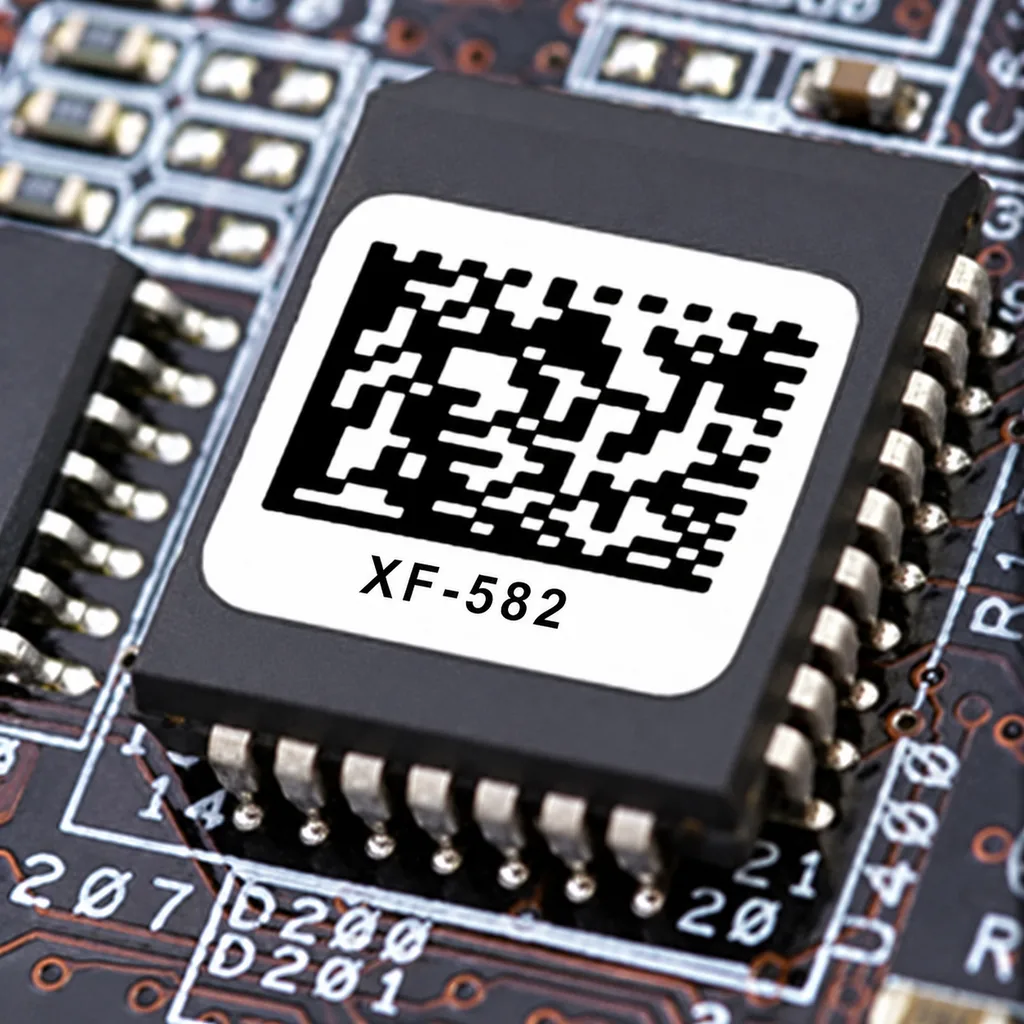
CL-582 High-Temperature Polyimide Labels for Printed Circuit Board Traceability
CL-582 is a high-temperature polyimide (PI) label material for printed circuit board (PCB) and sensitive electronic component process control and product traceability. It has a gloss white coating, a listed thickness of 2mil and an acrylic adhesive. The source identifies wave soldering and reflow soldering as applications. Selection requires confirmation of the actual heat exposure and chemical conditions: the listed temperature range has no specified exposure duration, and solvent resistance is qualitative.
View details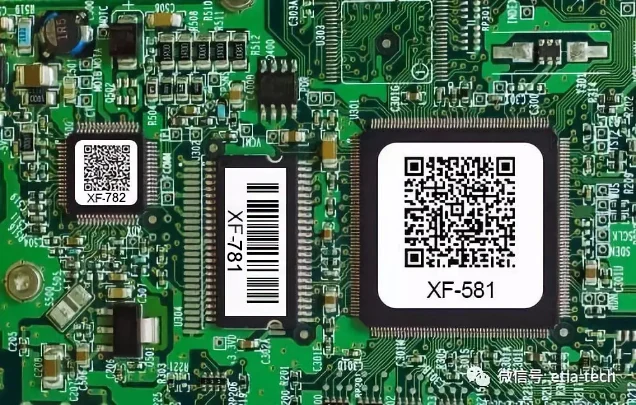
Anti-Static High-Temperature Polyimide Label
Anti-static polyimide label for ESD-sensitive electronics assembly and high-temperature…
View details
Antistatic Polyimide Labels for PCB Process Tracking — CL-782
CL-782 is a white gloss polyimide (PI) label material for printed circuit board (PCB) and sensitive-component process control and product traceability in electronics manufacturing. It is described for wave soldering and reflow soldering applications, with a listed temperature range of -40-300℃, an antistatic value of ≥10^(8)Ω and ≤10^(11)Ω, and a peel voltage below 100 volts. Selection should account for the actual thermal cycle and chemical exposure; the supplied information does not specify exposure durations or chemical test conditions.
View detailsNeed the right ribbon for your label application?
Share the label material, printer and operating environment. Our team will recommend a tested combination.
