
Security Hologram (Hologramme de Sécurité): What It Is, How It Differs, and What It Cannot Prove
Request a solution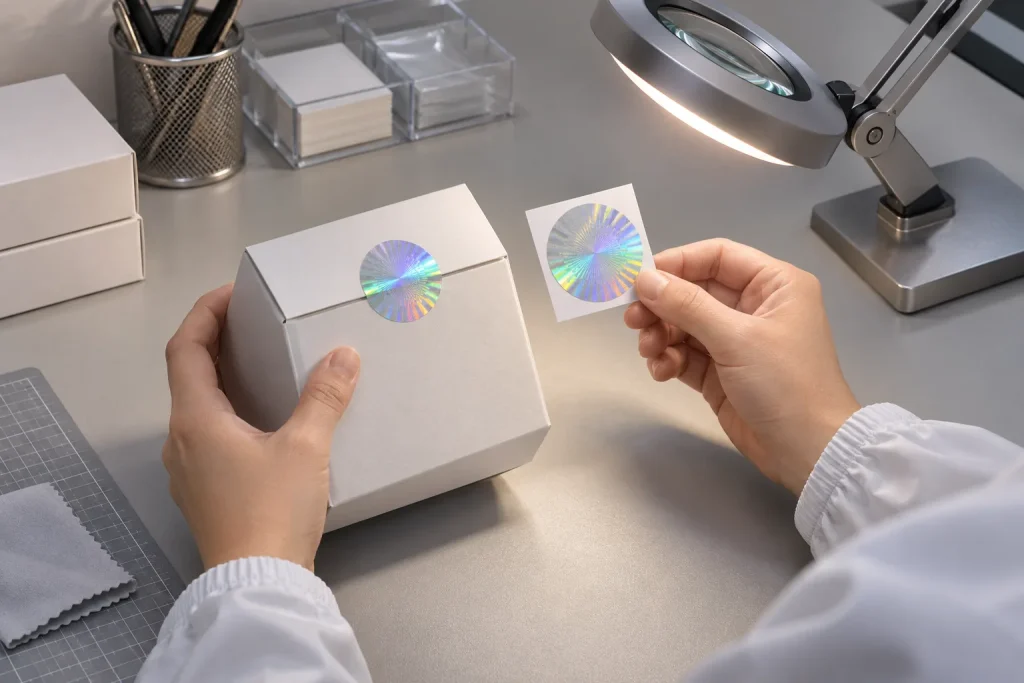
- Original TTR manufacturer since 2013
- Automated coating and slitting
- IQC / IPQC / OQC control
- ANSI barcode grade testing
- -20°C to 120°C environmental testing
- Batch-level traceability
- ANSI barcode grade
- Batch traceability
- RoHS / REACH compliance
- SGS and MSDS documents on request
A security hologram (in French, hologramme de sécurité) is a defined optical feature on a label, seal or package that people check by eye. This guide is written for B2B buyers and printing-plant technical teams who meet the term in label or packaging specifications. Its conclusion: a hologram supports physical inspection but is not an authenticity guarantee on its own, so it needs an authorised reference and a named checker, and unit-level codes only where the application actually needs unit-level identity.
Key Takeaways
- A hologram security label supports physical inspection through defined optical features.
- Decorative holographic film is produced for visual appeal, while a security hologram is a defined feature that an inspector checks against an authorised reference.
- A reflective or colour-changing surface does not by itself establish a product's origin.
- Where unit-level identity matters, a QR code or serial number set up as a unique identity per unit and checked by a verification service can work alongside the hologram.
- Some thermal transfer ribbons can print images in hologram form or visible only under ultraviolet light to support anti-counterfeit verification.
What a Security Hologram Is and How It Works
A security hologram is an image built into a label, seal or package so that an inspector can check it by eye through defined optical features. Holostik's technical selection material states the function plainly: a hologram security label supports physical inspection through defined optical features.
The optical effect alone is not the security. A workable security application defines the optical feature to inspect, an authorised reference and who performs the check. Without a named feature, inspectors describe the same label differently; without an authorised reference, nobody can say which version is genuine; without a defined checker, nobody inspects the pack at all.

How a Security Hologram Differs from Adjacent Features
A security hologram differs from decorative holographic film, printed codes and tamper-evident structures in what it shows and who can check it. Three boundaries keep the categories clean.
Decorative film is the closest look-alike: shelf foils are produced for visual appeal, while a security hologram is specified as a feature to inspect, backed by a defined optical feature, an authorised reference and a named checker. A reflective or colour-changing surface does not by itself establish a product's origin.
Printed codes answer a different question. A serial number can sit on each individual product as a label, laser marking, Data Matrix code or RFID tag, and it identifies one unit rather than one artwork. A QR that opens a webpage differs from an identity assigned to an individual unit and checked by a verification service. Holostik describes QR and serial-number options alongside holographic security: the hologram for fast human checks, the code for unit-level verification. If you print such codes in-house, see industrial serial number marking for how unit identity is produced.
Tamper-evident structures can provide evidence of an opening or removal, not proof of origin. Holostik's official OVD portfolio describes VOID, partial-transfer and destructive structures. None of these structures proves that the goods inside a genuine, unopened pack match the pack's claims.
| Feature | What it provides | How it is checked | What it does not prove |
|---|---|---|---|
| Security hologram (OVD) | Defined optical features for fast visual inspection | A person inspects the feature against an authorised reference | Origin or authenticity on its own |
| QR code or serial number | Unit identity plus data access, where the system assigns a unique identity to each unit | Scanning, and a verification service where one is configured for unit identity | Security if the code only opens a webpage |
| VOID or destructive seal | Evidence that a pack was opened or a label removed | Visual check after an opening or removal attempt | That the goods inside the pack are genuine |
| Decorative holographic foil | Shelf appeal and print differentiation | Where no security check is specified, no corresponding inspection basis is provided | Any claim of authenticity |

Where the Concept Meets Label Printing and Sourcing
Some authenticity effects can be produced at the printing step itself. Industry documentation on thermal transfer ribbons notes ribbons that make it possible to achieve the printed image in the form of a hologram, and ribbons whose image is visible only in ultraviolet light, both used to support anti-counterfeit verification of products. For a printing plant, the security layer is not always a foil purchase; sometimes it is a ribbon choice. Confirm the exact ribbon grade against your printer and label stock before promising the effect on a customer job.
This is also where Colorfulttr connects to the topic. Colorfulttr (Shenzhen Colorfulttr Technology Co., Ltd.) is a manufacturing company focused on thermal transfer ribbon research, production and sales. Its special-label catalogue of August 2026 lists a one-time uncovering anti-counterfeiting label that combines a QR code with fragile paper for sealing food packaging, plus anti-counterfeiting ticket printing that applies variable QR codes to scenic-spot tickets. The catalogue states what is listed, not what fits a given case: if a specification raises identity or tamper-evidence needs, verify the specific application — substrate, printer model and print volume — with the supplier before choosing any label-and-ribbon combination.
Data and Evidence
The table below restates the load-bearing statements with their conditions and sources.
| Statement | Condition or scope | Documentation |
|---|---|---|
| A hologram security label supports physical inspection through defined optical features | Needs a defined feature, an authorised reference and a named checker | Holostik technical selection material |
| It is not an authenticity guarantee on its own | Must be evaluated with the controls required for counterfeiting, tampering or product identity | Security-printing reference, source ID fact-c8b9641983203b299116a0eb |
| Reuse of original packaging, copying a valid code and unauthorised supply-chain movement require different controls | Three listed risks; the source does not specify the control measures | Security-printing reference, source ID fact-4c448e39435eb37320b7db6d |
| QR and serial-number options sit alongside holographic security | A webpage QR differs from a unit identity checked by a verification service | Holostik |
| OVD structures include VOID, partial-transfer and destructive types | Structure types as listed in that portfolio | Holostik OVD portfolio |
| Ribbons exist that print hologram-form or ultraviolet-only images | Specific ribbon grades; confirm per printer and label stock | Thermal transfer industry reference, source ID fact-c6f90f6bae2dc48fa84357c9 |
| Colorfulttr's catalogue includes QR anti-counterfeit labels on fragile paper | Catalogue items; suitability confirmed per application | Colorfulttr special-label catalogue, 2026-08 |
When you audit a hologram specification, work through a short checklist:
- Write the exact optical feature inspectors will look for in one sentence.
- Agree which sample counts as the authorised reference.
- Name who performs the check, and at which point in your process.
- Where unit-level identity matters, confirm the code carries an identity assigned to an individual unit and checked by a verification service; a QR that only opens a webpage is not the same thing.
- If the risks you need to cover are reuse of original packaging, copying a valid code or unauthorised supply-chain movement, treat them separately — they require different controls beyond the hologram and the code.
Frequently Asked Questions
Is a security hologram enough to prove that a product is authentic?
No, a hologram is not an authenticity guarantee on its own. It supports fast visual inspection, but you must evaluate it with the controls required for counterfeiting, tampering or product identity. Reuse of original packaging, copying a valid code and unauthorised supply-chain movement require different controls. Add unit-level codes and a defined verification process only where your application needs unit-level identity, not as a default pairing.
What is the difference between a security hologram and a QR code label?
A security hologram is checked optically by a person against an authorised reference, while a QR code carries data that a scanner reads. A code set up as an identity assigned to an individual unit and checked by a verification service supports unit-level identity verification; a QR that opens a webpage is not the same thing, so match the code setup to the proof you need.
Can a thermal transfer ribbon print hologram or ultraviolet security effects?
Yes, special ribbons exist for this purpose. Industry documentation describes ribbons that achieve the printed image in the form of a hologram, and ribbons whose image is visible only in ultraviolet light, both used to support anti-counterfeit verification of products. Availability depends on the ribbon grade, so confirm the effect with your supplier for your printer and label stock before quoting it to an end customer.
Recommended products for this industry
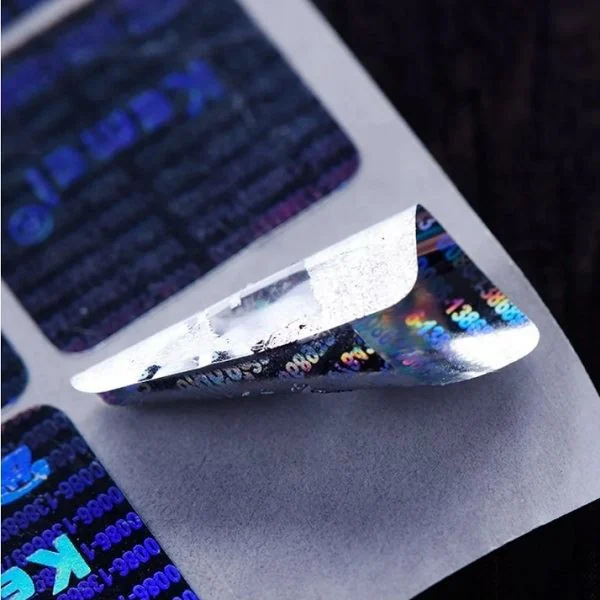
Hologram Security Label
Reflective holographic security label with visual authentication for brand protection and…
View details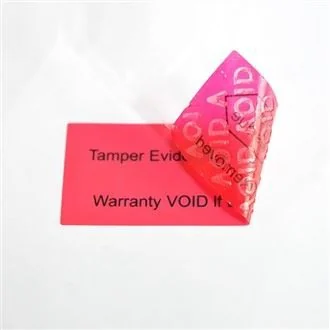
VOID Tamper Evident Security Label
Security label that reveals a tamper message when lifted, helping protect equipment…
View details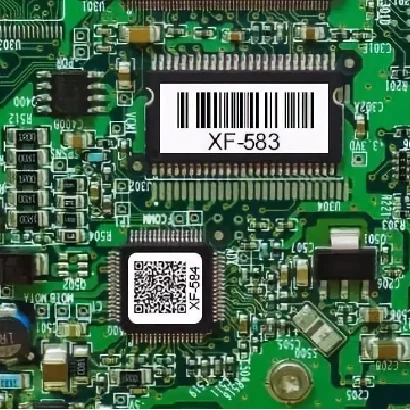
Washable High-Temperature Polyimide Label
Strong-adhesion polyimide label for electronics that pass through washing, soldering and…
View details
Water Sensitive Indicator Label
Irreversible water-contact indicator for electronics, batteries and devices requiring…
View detailsNeed the right ribbon for your label application?
Share the label material, printer and operating environment. Our team will recommend a tested combination.
