
- Original TTR manufacturer since 2013
- Automated coating and slitting
- IQC / IPQC / OQC control
- ANSI barcode grade testing
- -20°C to 120°C environmental testing
- Batch-level traceability
- ANSI barcode grade
- Batch traceability
- RoHS / REACH compliance
- SGS and MSDS documents on request
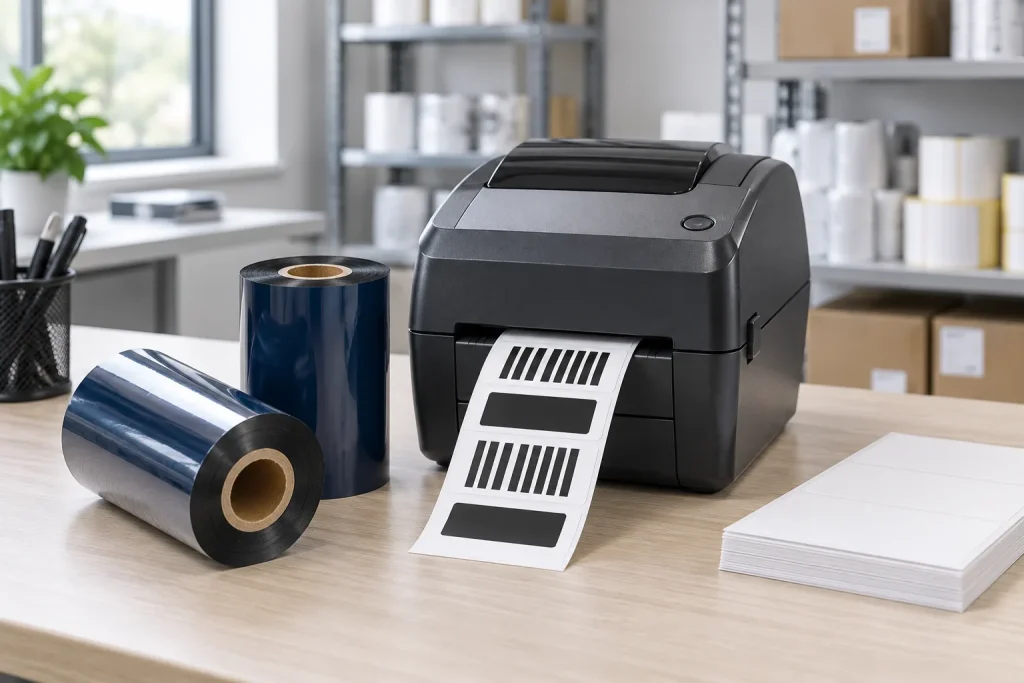
For label buyers and print technicians, wax-resin identifies a thermal transfer ink blend that offers greater durability than wax ribbon. It is commonly considered for coated paper and selected films, with suitability determined by the specific formulation and printing system. Confirm the candidate on the intended label surface and printer before approving a replacement.
Key Takeaways
- Wax-resin combines wax and resin in the ribbon ink layer.
- Coated paper and selected synthetic materials are common starting points for wax-resin evaluation.
- The ink family does not establish compatibility with every printer or film.
- A supplier change requires validation of the complete printed combination.
What the wax-resin name tells you about the ribbon
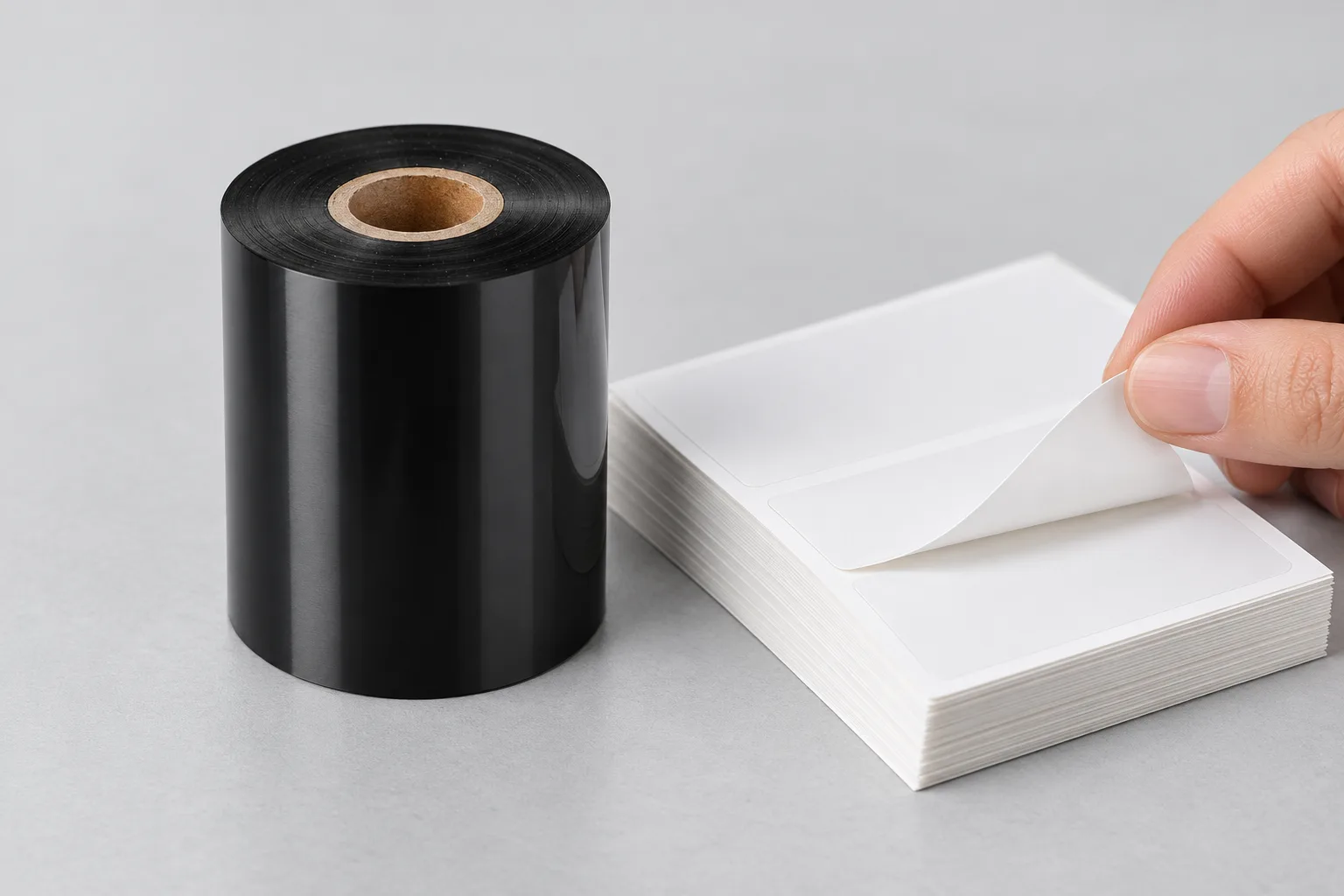
Wax-resin ribbon is a thermal transfer ribbon with an ink layer that blends wax and resin, providing enhanced durability compared with wax ribbon. For a buyer, the useful meaning is a material category: it helps narrow the discussion about the label surface and expected handling. It does not identify a complete product specification or a universal replacement for an existing roll.
The name comes from the ink formulation. A thermal transfer ribbon consists of a thin film carrying ink on one side; that ink may be wax-based, resin-based or a wax-resin mixture. During printing, the printhead applies heat against the back of the ribbon and the released ink transfers onto the label beneath it. The ribbon is therefore the ink carrier, while the label material is the surface receiving the image.
This distinction helps when a specification simply says “wax-resin label.” Ask whether the document means the ribbon being used or the label surface intended for printing. Record those as separate items: ribbon grade and label material. A statement about the ink category cannot, by itself, describe the complete label construction.
Use the category as the opening question in a technical discussion: “Is this wax-resin formulation intended for our label surface and printing system?” That question is more useful than treating two products with the same category name as already equivalent.
How wax-resin differs from wax and full resin
Thermal transfer ribbons are commonly grouped into full wax, wax-resin blend and full resin, with different general media associations. Wax is generally associated with porous and coated paper, wax-resin with coated paper and selected synthetics, and full resin with demanding synthetic films such as polyester, polyimide and vinyl. These are starting points for comparison rather than a replacement for grade-specific information.
The practical distinction between wax and wax-resin is that the blend offers enhanced durability compared with wax. That makes wax-resin relevant when a paper-label application needs a more durable printed image. It does not supply a numerical improvement, a guaranteed service life or a particular resistance rating. Those conclusions require information for the exact combination being considered.
There is also overlap between the categories. Coated paper appears in both the general wax and wax-resin guidance, so the material name alone does not settle the choice. Define what the printed label must withstand, then compare the candidate formulations against that requirement. Avoid choosing only from a category hierarchy without checking the actual application.
COLORFULTTR’s current product list illustrates variation within wax-resin itself: JT105 is described as a general-purpose blend, while CL508T is described as scratch-resistant and suitable for film materials. These descriptions show why the grade matters. They do not establish that either grade is suitable for every paper or film job, nor do they establish equal performance between grades.
Why the ink category does not establish printer compatibility
Ribbon choice depends on the formulation, printer architecture, print settings and required durability as well as the label surface. Keep these questions separate when reviewing a specification. First establish which printing system the ribbon is intended for; then assess whether the proposed grade suits the actual material and performance requirement.
TTO provides a useful example of the distinction. Thermal Transfer Overprinting applies codes to flexible packaging using a thermal printhead and a wax-resin or resin ribbon. “Wax-resin” describes the ink blend; “TTO” describes the printing technology. Seeing wax-resin in both a label-ribbon description and a packaging-ribbon description does not establish that the rolls are interchangeable.
Within COLORFULTTR’s range, CL926 is identified as a near-edge TTO wax-resin grade. The current specification list states that its TTO range is not for flat-head barcode printers. That restriction belongs beside the product choice: a buyer should not select CL926 for a flat-head label printer simply because the requested ink family is wax-resin.
For a supplier change, describe the proposed replacement by its exact grade, intended printer system and label surface. Compare those details with the existing application before evaluating the print result. If the candidate’s intended architecture is unclear, resolve that question before interpreting a sample as evidence of compatibility. A shared category name is a reason to investigate the candidate, not an approval decision.

What to verify before treating two grades as equivalent
Ribbon performance belongs to the complete printed combination, so a replacement needs validation on the actual label material, printer and settings before release. The useful output of an evaluation is an approved combination with recorded conditions. A category description alone cannot provide that result.
Keep the comparison focused on the job that prompted it. For example, if the concern is handling durability on coated paper, state that requirement explicitly instead of asking only for a “better ribbon.” If the concern is a new film, identify that surface rather than assuming the previous approval extends to it. These questions turn the broad ink category into a specific evaluation request.
- Record the exact label material, printer and existing ribbon grade.
- Confirm the candidate grade’s intended media and printer architecture.
- Print the intended job on your own combination and record the settings used.
- Check the resulting image against the application’s defined durability requirements before release.
Do not infer chemical resistance, heat resistance or a service-life guarantee solely from the wax-resin name. Likewise, treat an existing printer setting as part of the comparison record, rather than evidence that another formulation will behave identically. If the candidate fails your requirement, return to the specific formulation, material and printing conditions instead of approving or rejecting the whole wax-resin category from one result.
Data and Evidence
The available evidence supports a category-level explanation and grade-specific distinctions, rather than one universal operating specification for wax-resin ribbon. Use the following comparison to separate what the information establishes from what your application still needs to confirm.
| Evidence | Supported interpretation | Application check |
|---|---|---|
| Wax-resin is a blend of wax and resin. | The name identifies the ink family. | Identify the exact grade under review. |
| General media guidance lists coated paper and selected synthetics. | These surfaces are relevant starting points. | Confirm the actual label surface with the candidate formulation. |
| JT105 and CL508T have different grade descriptions. | Products within the family have distinct positioning. | Match the grade description to the intended job. |
| CL926 is a near-edge TTO blend. | Ink family and printer architecture are separate attributes. | Confirm the printing system before considering a substitution. |
Grade descriptions and the TTO restriction are drawn from 公司现行数字系型号规格清单. The category explanation follows the supplied “Wax-resin ribbons” and “thermal transfer ribbons” references. These sources explain the terminology; they do not provide a universal wax-resin ratio, operating temperature or application acceptance threshold.
Your next step is to write a short application record containing the label surface, printer, exact candidate grade and required durability. Use that record to arrange a sample evaluation of the intended combination.
Frequently Asked Questions
Does wax-resin ribbon work on every synthetic label?
No. Wax-resin is generally associated with coated paper and selected synthetics. Check the exact ribbon formulation against the actual label surface, printer and required durability.
Is wax-resin ribbon the same as TTO ribbon?
Wax-resin describes the ink blend, while TTO describes a printing technology. TTO can use wax-resin or resin ribbon, so the ink category alone does not establish printer compatibility.
Can I keep the same print settings when changing wax-resin suppliers?
Treat the existing settings as information for the comparison, rather than proof of equivalence. Validate the replacement on your own label material and printer before release.
Recommended products for this industry
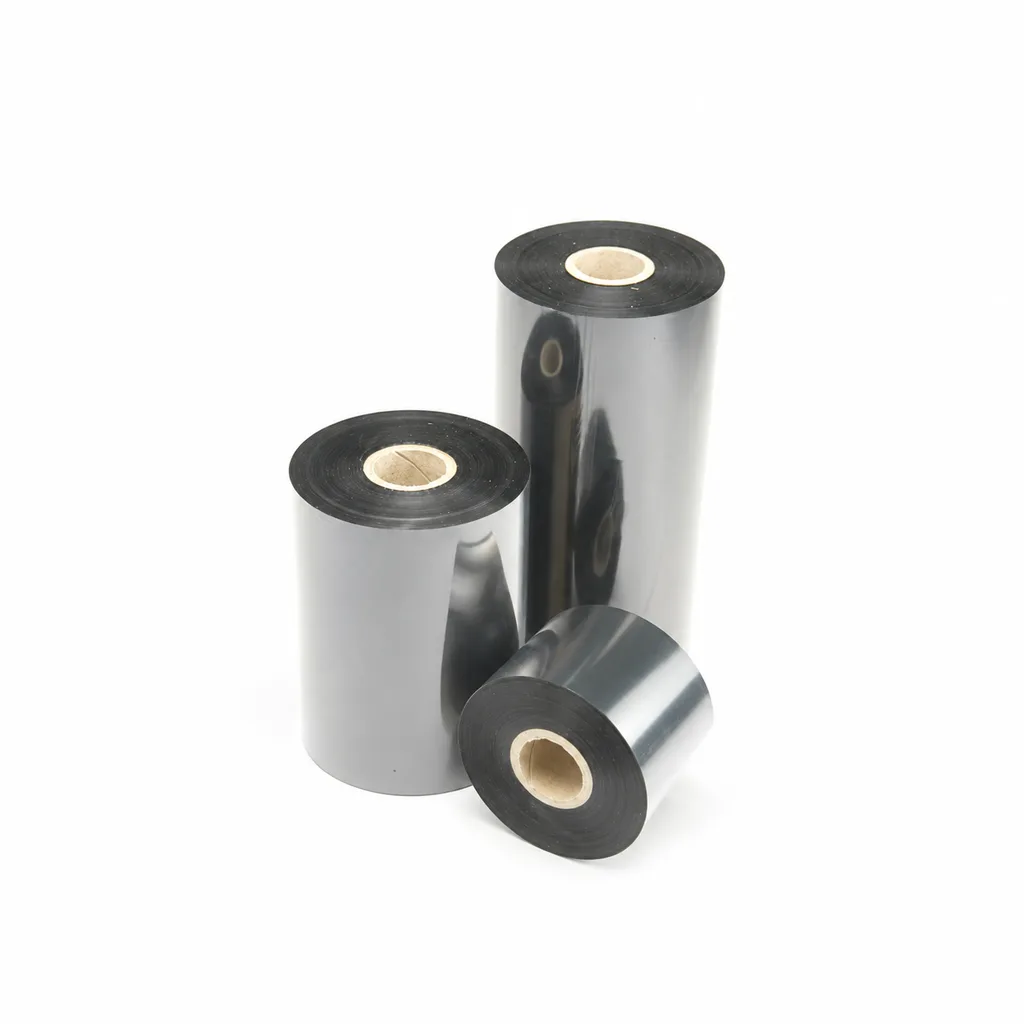
CL-Z203 Wax-Resin Thermal Transfer Ribbon for Barcode Labels
A black wax-resin thermal transfer ribbon for flat-head printing, with listed applications including retail, warehousing, logistics and garment tags. Select it against your actual label material and desktop or industrial barcode printer at speeds ≤6 ips (inches per second). Fine-line, small-text and durability results were obtained on coated paper; print quality and image durability may vary with the printer and printing substrate.
View details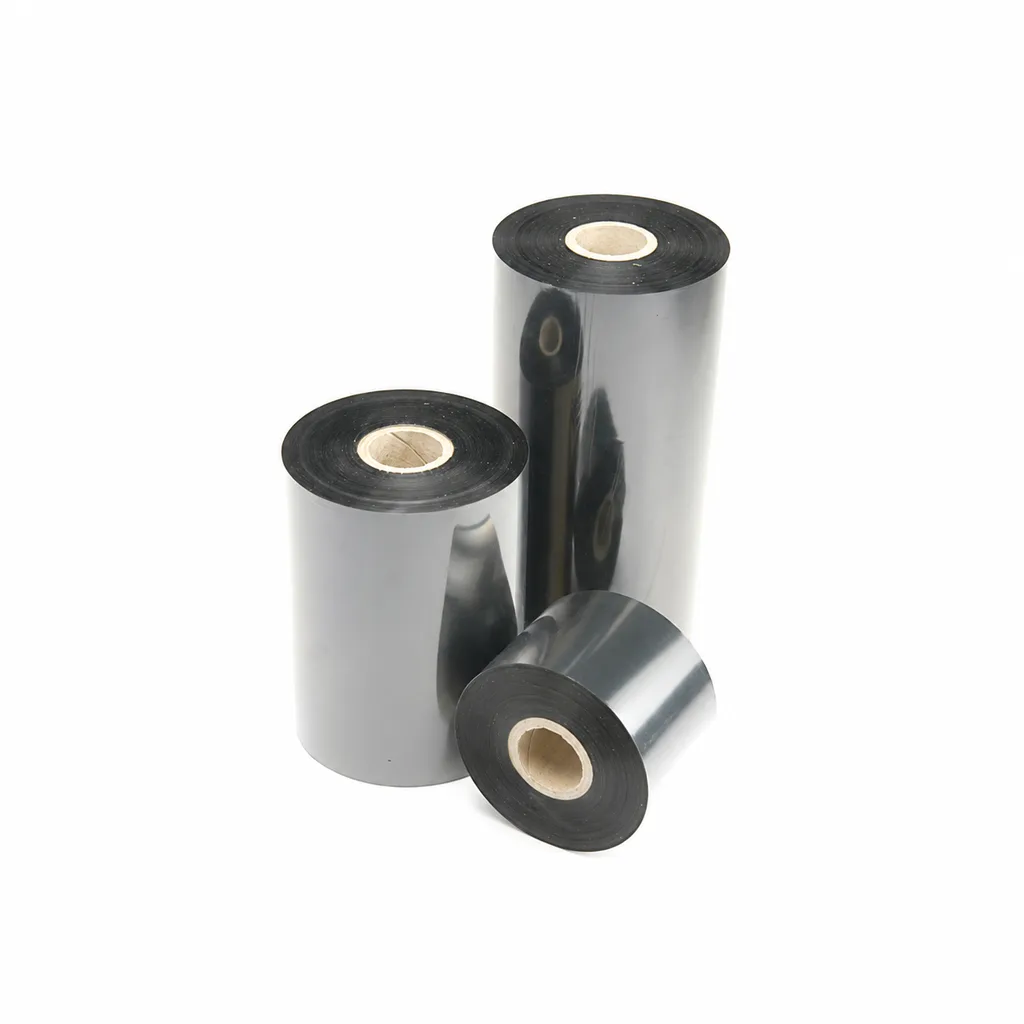
CL-Z213 Near-Edge Wax-Resin Thermal Transfer Ribbon for Barcode Labels
An enhanced black near-edge wax-resin thermal transfer ribbon for near-edge barcode printers and low- to medium-speed thermal transfer overprinting (TTO). Listed applications include retail labels, warehousing, garment tags and packaging identification. Match the printer, actual print medium and operating speed before selection: print quality and image durability can vary with the printer and substrate.
View details
Fully resin-based ribbon
Resin-based ribbons offer superior scratch resistance, high-temperature tolerance…
View details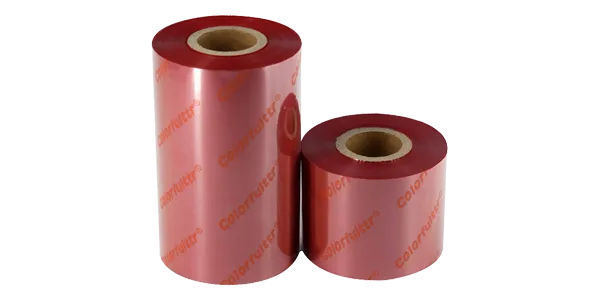
High-grade wax resin thermal transfer ribbon
Premium wax-resin thermal transfer ribbons are specifically engineered for diverse…
View detailsNeed the right ribbon for your label application?
Share the label material, printer and operating environment. Our team will recommend a tested combination.
