
How to Choose Low Surface Energy Labels: Surface, Temperature and Ribbon Match
Request a solution
- Original TTR manufacturer since 2013
- Automated coating and slitting
- IQC / IPQC / OQC control
- ANSI barcode grade testing
- -20°C to 120°C environmental testing
- Batch-level traceability
- ANSI barcode grade
- Batch traceability
- RoHS / REACH compliance
- SGS and MSDS documents on request
Key Takeaways
- Low surface energy surfaces are the ones standard pressure-sensitive adhesives wet poorly, so label adhesion and print anchoring both need verification, not assumption.
- Surface condition is a selection gate: GWBQ special-label listings describe constructions for rough surfaces, curved surfaces, and cold steel coils.
- Listings pair constructions with temperatures, from an art paper label at minus 20 Degrees to aluminum foil label material at 370 Degrees for steel mills.
- Ribbon family controls print durability: wax for low-cost, high-volume paper labels, wax-resin for glossy or matte paper labels, resin where quality requirements and resistance outweigh cost.
- No listing rating replaces a trial — test the exact label and ribbon on your surface, printer, and coldest and hottest service conditions before ordering volume.
What Low Surface Energy Means for Label Buyers
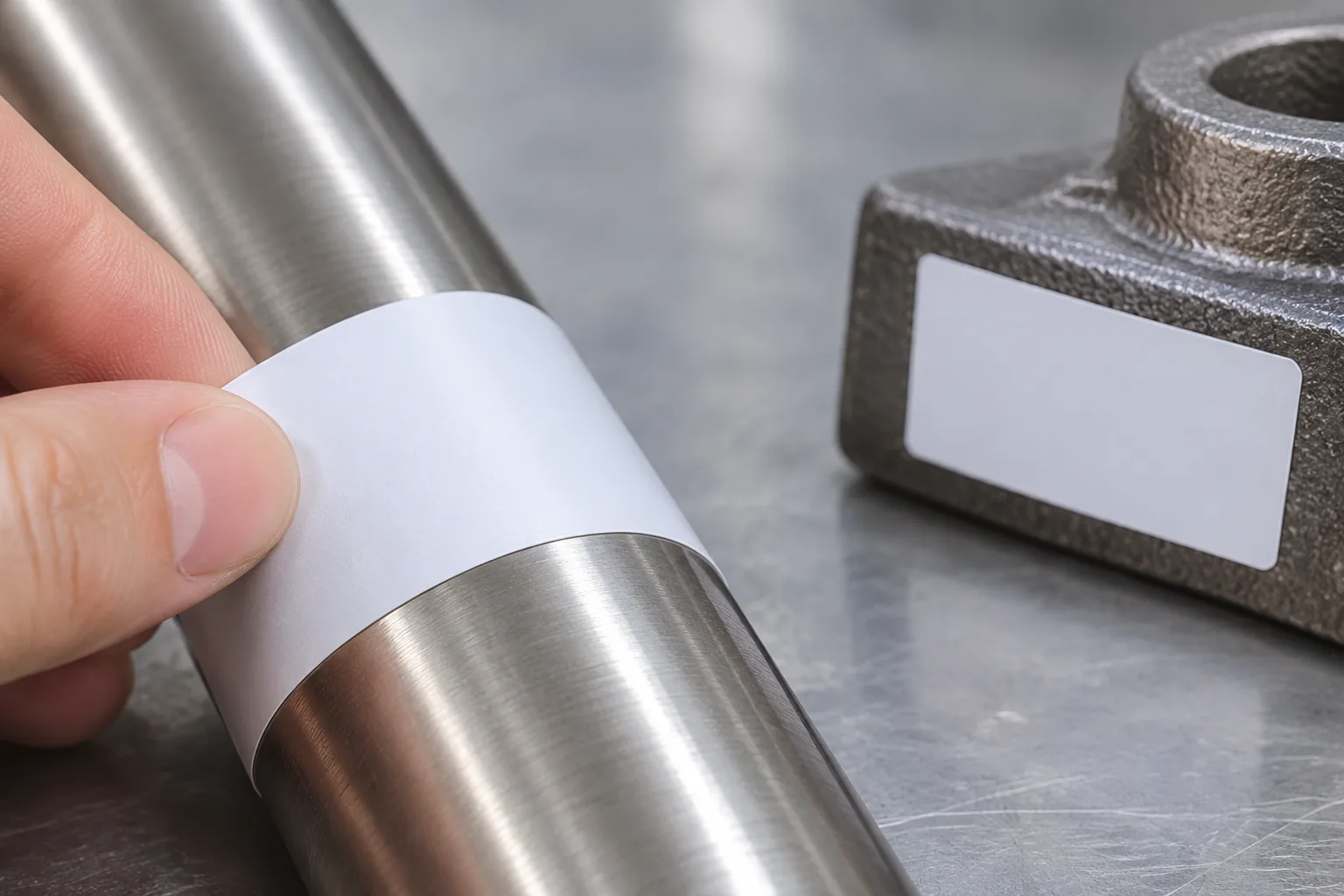
Low surface energy describes plastics, films, and coated finishes that pressure-sensitive adhesives wet poorly, which is why a label that holds on cardboard can lift at the edges on a slick plastic housing or a coated panel.
That definition exposes the two failures a buyer has to prevent. Adhesion failure shows up as edge lift, curling, or a label that falls off after handling or temperature swings. Print failure is quieter: an image that never anchored well scratches off or stops scanning. Both are selection problems, and both are checkable before you buy in volume. On the print side, consumables which the labels are made from need to have the right surface layer, and the ribbon has to supply ink of appropriate quality so the printed image keeps the durability the application requires.
Treat “low surface energy” as a condition to verify rather than a product category to hunt for. Shortlist labels whose own descriptions state what your case needs: strong adhesion, the surface type you have, and a temperature rating that covers your service range. If you print labels in-house on a thermal transfer printer, add the ribbon to the same shortlist, because label and ribbon pass or fail together in the same trial.
Check Surface Condition and Temperature Before You Shortlist
The condition of the target surface and the temperatures it reaches decide which constructions can qualify, so write down both before comparing products.
Start with geometry. Rough or uneven surfaces need constructions that state rough-surface adhesion: a GWBQ steel-industry listing describes label SD360 for medium thick board that can stick on rough surface. Curved parts need adhesive that follows the curve — a GWBQ aluminum foil listing pairs strong adhesive with curved surface stickers for steel moderate thickness plate — and strongly contoured shapes may need a different geometry altogether, not just more adhesive; the holographic-label guide from NovaVision tells buyers to choose an oval shape for contoured surfaces such as baseballs and footballs.
Then temperature. Listings describe low-temperature constructions across a wide span: an art paper label with strong adhesion and friction resistance at minus 20 Degrees, fragile synthetic paper at minus 40 Degrees, and a PET label with ultra-low temperature resistance to minus 80 Degrees for the steel industry. For labeling cold steel, one synthetic paper listing states the label can stick steel cold rolled coil at low temperature. On the hot side, listings cover a PET tag at 180 degrees with weather resistance, a bright white PET label at 200 Degrees, anti-static polyimide (PI) labels for hot rolled coil, and aluminum foil label material at 370 Degrees.
Finally, check behavior over time. A cable-label listing states no opening, no curling, and strong sticking for a winding flag type — the behavior you want on surfaces that flex or vibrate. A furniture listing states the opposite priority: paste firmly yet open without glue residue on a variety of furniture surfaces. A rating stated for one listing belongs to that construction only, so shortlist by the description that matches your case instead of generalizing across the range.

Match the Ribbon to the Label Face for Print That Survives
A printed label survives its application only when the ribbon ink and the label face are matched, because the label face needs the right surface layer and the ribbon must supply ink quality suited to the durability the use requires.
A thermal transfer ribbon is a polyester film coated on the label side with a wax, wax-resin or pure resin “ink”, and the printer’s heat melts that coating onto the face. Each family covers a different band of cost and resistance. Wax ribbons are best for low-cost, high-volume printing on paper labels — product and logistics labels across many industries — with low printing temperature and high-speed printing up to 254 mm/s as added advantages. Wax-resin ribbon ensures durable and clear printing of barcodes, texts and graphics on glossy or matte paper labels. Resin ribbons, whose ink is based mainly on resin with appropriate additives, are the industry choice for nameplates, product and identification labels where cost is less significant than quality requirements and resistance.
Before ordering, confirm the physical fit. Ribbon width follows each printer maker’s guidelines, and suppliers such as Etisoft pre-assemble ribbons of various widths in IN or OUT winding for brands including ZEBRA, CITIZEN, TSC, PRINTRONIX, SATO, and HONEYWELL. If the job prints directly on film packaging instead of onto labels, that is a thermal transfer overprinter, which prints by melting a coating of ribbon so the image stays glued once applied — but contact printing limits it to flexible packaging, with barcode speeds typically restricted to about 800mm\s. Check which material you will be printing on before purchasing, and note that printheads commonly resolve 203 or 300 dpi, while 600 dpi printers exist for very small electronics barcodes.
Pick the least expensive family that passes your sample test. Moving from wax to wax-resin or resin buys durability at higher cost, and the trial below tells you which band your application actually needs.
Data and Evidence
The tables collect the specifications this guide relies on, so each recommendation can be traced to its stated source context.
| Ribbon family | Stated best use | Key conditions |
|---|---|---|
| Wax | Low-cost, high-volume printing on paper labels; product and logistics labels | Low printing temperature; high-speed printing up to 254 mm/s |
| Wax-resin | Durable, clear barcodes, texts and graphics on glossy or matte paper labels | Wax-resin TTO ribbons most often used by food and hygiene product manufacturers |
| Resin | Nameplates, product and identification labels | Ink based mainly on resin with additives; used where cost is less significant than quality requirements and resistance |
| Listed GWBQ example | Described conditions |
|---|---|
| PET label, steel industry | Ultra-low temperature resistance to minus 80 Degrees; strong adhesive |
| Synthetic paper label | High and low temperature resistant; low temperature can stick steel cold rolled coil |
| Art paper label | Minus 20 Degrees; strong adhesion; friction resistance |
| Fragile synthetic paper label | Minus 40 Degrees; anti-counterfeiting; strong viscosity |
| PET tag, listing | 180 degrees; weather resistance |
| Bright white PET label | 200 Degrees; steel industry |
| Polyimide (PI) label | High temperature resistant; anti-static; hot rolled coil |
| Aluminum foil label material | 370 Degrees; steel mill |
| SD360 steel industry label | Medium thick board; can stick on rough surface |
| SD202W cable label | Winding flag type; no opening, no curling; strong sticking |
| H215L furniture label | Thermosensitive paper; paste firmly; opened without glue residue on a variety of furniture surfaces |
Verify before volume with four steps:
- Order samples of the shortlisted construction together with the ribbon family matched to its face.
- Apply the samples to the actual surface at your coldest and hottest expected service temperatures, including a curved or rough spot if that reflects the real part.
- Check the edges for lift or curl once the labels have sat, and confirm the print stays legible and the barcode scans after normal handling.
- Record the surface, application temperature, printer, and ribbon family for each trial so results repeat cleanly.
Next step: build the shortlist from the two checks above, then request label and ribbon samples and run the four-step trial on your own line. Treat listing ratings as entry conditions for the trial, not as acceptance results for a whole batch.
Frequently Asked Questions
What are low surface energy labels?
Labels chosen for surfaces that standard pressure-sensitive adhesives wet poorly, such as slick plastics, coated panels, or rough and curved parts. Select by three checks: stated adhesion for your surface type, the surface condition, and a temperature rating that covers your service range, then confirm with a sample trial.
Which thermal transfer ribbon works on low surface energy labels?
Match the ribbon to the face and the durability the job needs: wax for low-cost, high-volume paper labels, wax-resin for durable printing on glossy or matte paper labels, and resin where quality requirements and resistance outweigh cost. Because the label face must anchor the ink, always run a print sample before ordering a batch.
Can I label cold steel coils without the adhesive failing?
Shortlist constructions described for low-temperature use: listings include a synthetic paper label that can stick steel cold rolled coil at low temperature and a PET label with ultra-low temperature resistance to minus 80 Degrees. Apply a sample at your real coil temperature and check the edges before committing.
How do I test labels on curved or rough surfaces before ordering?
Order samples of the shortlisted label with a matching ribbon, apply them to the real surface at your coldest and hottest expected conditions, then check for edge lift or curl and confirm the print stays legible and scannable after handling. Record the surface, temperature, printer, and ribbon family so the trial repeats cleanly.
What print resolution do I need for small barcode labels?
Thermal printheads commonly resolve 203 or 300 dpi, and some manufacturers make 600 dpi printers for very small barcodes in the electronics industry. Pay for 600 dpi only when your barcode size actually demands it.
Recommended products for this industry
Low-Surface-Energy PET Label
High-tack PET label designed for low-surface-energy plastics and textured industrial…
View details
Aluminum Foil High-Temperature Label
Coated aluminum label for metal processing, heat treatment and high-temperature part…
View details
Anti-Static High-Temperature Polyimide Label
Anti-static polyimide label for ESD-sensitive electronics assembly and high-temperature…
View details
Black High-Temperature Polyimide Label
Matte-black polyimide label for high-contrast codes on dark electronics and industrial…
View detailsNeed the right ribbon for your label application?
Share the label material, printer and operating environment. Our team will recommend a tested combination.
