
Holographic Security Labels: What They Are, How They Differ, and What They Cannot Prove
Request a solution
- Original TTR manufacturer since 2013
- Automated coating and slitting
- IQC / IPQC / OQC control
- ANSI barcode grade testing
- -20°C to 120°C environmental testing
- Batch-level traceability
- ANSI barcode grade
- Batch traceability
- RoHS / REACH compliance
- SGS and MSDS documents on request
Key Takeaways
- A holographic security label carries a microscopic diffractive pattern embossed into a metallised or transparent film, creating a colour-shifting image that changes with the viewing angle.
- The hologram supports physical inspection through defined optical features, but it is not an authenticity guarantee on its own.
- A decorative holographic appearance is different from a controlled origination and inspection process, so matching shine alone says nothing about origin.
- Reuse of original packaging, copying a valid code and unauthorised supply-chain movement require different controls beyond any hologram.
- QR and serial-number options work alongside holographic security to give each unit a unique identity checked by a verification service.

What a Holographic Security Label Is
A holographic security label is a label whose security value comes from a microscopic diffractive pattern embossed into a metallised or transparent film. When light hits this microstructure, it diffracts into its component wavelengths and produces the colour-shifting effect that is the visual signature of a genuine hologram. The shifting, rainbow-like image changes with the viewing angle, and standard printing or photocopying cannot reproduce it.
The feature exists for fast, human checks. A hologram security label supports physical inspection through defined optical features, so an inspector compares what the label shows against a reference instead of running a laboratory test.
In Spanish-language specifications you will meet the same product as “etiquetas holográficas de seguridad”. The hologram itself can take several forms: a standalone patch, a full-surface metallised film, or one layer inside a broader label construction alongside print, VOID patterns or serialisation.
Where the Security Comes From and How Inspection Works
The security comes from a controlled origination process, not from the shiny look. The diffractive pattern is created by an origination process that etches a microstructure, invisible to the naked eye, into a master shim, which is then used to emboss the pattern onto a thin metallised or optically variable film. Because the microstructure is extremely fine and specific to the origination tooling used, a photocopier, scanner or standard printing press cannot capture or reproduce it, which is what makes holograms an effective overt security feature.
How much protection that buys depends on the tooling behind the image. The International Hologram Manufacturers Association argues that holograms on security labels are difficult to forge because they are replicated from a master hologram that requires expensive, specialised equipment. Public criticism recorded in the same reference makes two counterpoints: manufacturing equipment has become significantly easier to access, and few people have the expertise and equipment to authenticate a hologram accurately.
Serious programs therefore treat inspection as a defined procedure, not a glance. A security application defines the optical feature to inspect, an authorised reference and who performs the check. In regulated medicines supply chains, pharmacies and hospitals scan each medicine at the end of the supply chain to verify its authenticity before dispensing — verification is a process with an owner.
How It Differs From Decorative Foil, Serial Numbers and Tamper Seals
A decorative holographic appearance is different from that controlled process. Decorative foil is chosen for its look: nobody has defined an optical feature, a reference image or a checker, so a matching shine says nothing about who made the product. A reflective or colour-changing surface does not by itself establish a product’s origin.
Serial numbers and QR codes answer a different question: which exact unit is this? A serial number can sit on each individual product as a label, laser marking, Data Matrix code or RFID tag, and serial numbers uniquely identify each product even when it is identical to others from the same line. Holostik describes QR and serial-number options alongside holographic security because the two layers cover different risks: the hologram gives a fast visual check, while the serial gives a database check.
One caution sits inside the code layer itself. A QR that opens a webpage differs from an identity assigned to an individual unit and checked by a verification service, and only the second arrangement authenticates a specific item.
Tamper evidence is a third, separate layer. Holostik’s official OVD portfolio describes VOID, partial-transfer and destructive structures, where the evidence expected after opening or removal is defined in advance. Printed effects can imitate parts of this family too: specialty ribbons can print a hologram-form image or one visible only in ultraviolet light, which are used to ensure the authenticity of products. All of these layers sit inside the wider industrial-label world, where labels also enable supply chain traceability, satisfy regulatory disclosure requirements and carry machine-readable codes for automation.

What a Hologram Cannot Prove on Its Own
A hologram is evidence of a feature, not of authenticity. Evaluate it with the controls required for counterfeiting, tampering or product identity; it is not an authenticity guarantee on its own. Three common attacks walk straight past the shine: reuse of original packaging, copying a valid code and unauthorised supply-chain movement require different controls.
A workable program therefore layers controls instead of leaning on one feature. Keep the hologram for the fast visual check. Add serial numbers or QR identity checked by a verification service when you need unit-level authentication. Add VOID or destructive structures when opening or removal must leave visible evidence. Finally, check the rules that apply to your sector, because traceability, security or data-protection regulations may dictate what you must attach to each product.
This is where Colorfulttr supports such programs from the consumables side. Shenzhen Colorfulttr Technology Co., Ltd. has manufactured thermal transfer ribbons since 2013, covering wax, wax-resin, full resin, wash-care, TTO and card-ribbon lines. During printing, the thermal print head uses heat and pressure to transfer text and barcode information from the ribbon onto the label — including the serial numbers and QR codes printed next to a hologram. The company’s special-label product list also includes one-time anti-counterfeiting sealing labels on QR-code fragile paper for food packaging, plus synthetic anti-counterfeiting fragile paper, which serve the tamper branch. Company records list ISO 9001:2015 and ISO 14001:2015 management-system certifications and a 2023 BSCI audit, and standard samples come as 110 mm × 10 m rolls for regular ribbons and 33 mm × 50 m for TTO.
If you pair ribbons with security labels, confirm your printer model, label face material and code size with the supplier before ordering, then test on your own label stock before a production run.
Data and Evidence
The table below separates the four layers buyers most often confuse. Each layer verifies something different, and none of them covers the whole job alone.
| Layer | What it physically is | What it verifies | What it does not cover |
|---|---|---|---|
| Holographic (diffractive) feature | Microscopic pattern embossed into a metallised or transparent film | Fast visual inspection of a defined optical feature | Origin or authenticity on its own |
| Serial number / QR identity | A unique number on each unit, carried as a label, laser marking, Data Matrix code or RFID tag | Which exact unit this is, when checked by a verification service | Tampering; a QR that only opens a webpage is not unit identity |
| Tamper-evident structure | VOID, partial-transfer and destructive structures | Evidence after opening or removal | Product identity or origin |
| Decorative holographic foil | Shiny appearance without a controlled process | Visual decoration only | Origin or authenticity of the product |
The diffractive microstructure is etched into a master shim and then embossed onto film.
Use this verification sequence when you roll the feature out:
- Define the optical feature to inspect, the authorised reference and who performs the check before anything ships.
- Tilt the label under normal light and compare the colour shift and image movement against the authorised reference sample.
- For unit-level authenticity, let a verification service answer each scan instead of trusting a QR that only opens a webpage.
Frequently Asked Questions
Is a holographic security label enough to prove that a product is genuine?
No. It is not an authenticity guarantee on its own; it has to be evaluated with the controls required for counterfeiting, tampering or product identity. Keep the hologram for quick visual inspection, and add serial or QR identity plus tamper-evident structures where authenticity matters.
What is the difference between a holographic security label and a decorative holographic label?
A decorative holographic appearance is different from the controlled origination and inspection process behind a security hologram. A security application defines the optical feature to inspect, an authorised reference and who performs the check, while a reflective or colour-changing surface by itself does not establish a product’s origin.
Do holographic security labels replace QR codes and serial numbers?
No. Holostik describes QR and serial-number options alongside holographic security because the layers cover different risks. The hologram gives a fast visual check, a serial number uniquely identifies each unit, and a QR that merely opens a webpage differs from an identity checked by a verification service.
Recommended products for this industry
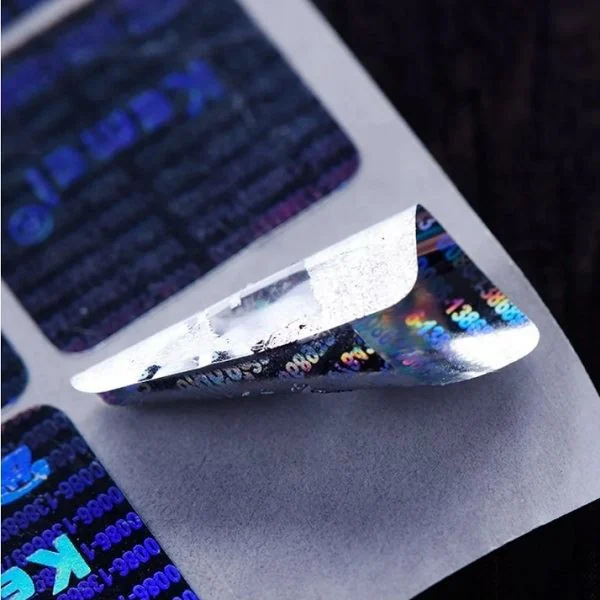
Hologram Security Label
Reflective holographic security label with visual authentication for brand protection and…
View details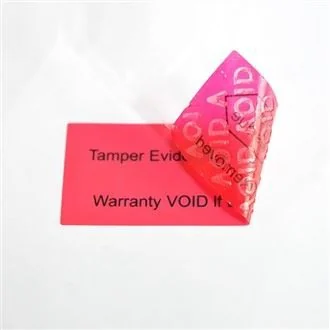
VOID Tamper Evident Security Label
Security label that reveals a tamper message when lifted, helping protect equipment…
View details
Acid and Alkali Resistant Label
Chemical-resistant label construction for acid baths, paint-stripping solutions, alkali…
View details
Aluminum Foil High-Temperature Label
Coated aluminum label for metal processing, heat treatment and high-temperature part…
View detailsNeed the right ribbon for your label application?
Share the label material, printer and operating environment. Our team will recommend a tested combination.
