
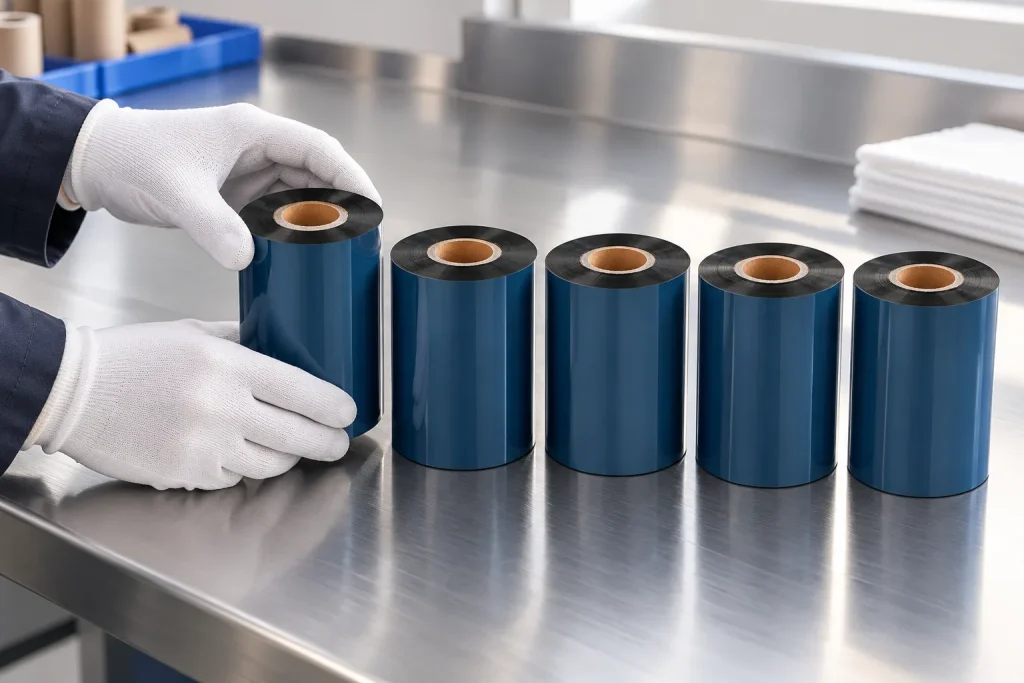
- Original TTR manufacturer since 2013
- Automated coating and slitting
- IQC / IPQC / OQC control
- ANSI barcode grade testing
- -20°C to 120°C environmental testing
- Batch-level traceability
- ANSI barcode grade
- Batch traceability
- RoHS / REACH compliance
- SGS and MSDS documents on request
TTR ribbon manufacturing turns coated film into printer consumables through formulation, coating, slitting and roll preparation. For printing teams and B2B buyers, understanding these stages helps separate ink suitability from roll fit and manufacturing capability from proven application performance. Verify a proposed ribbon against the exact printer, production label material and intended handling conditions before approving a supplier change.
Key Takeaways
- Thermal transfer ribbon uses an ink-coated film and a lubricated reverse side to support printing.
- Coating establishes the ribbon construction, while slitting and rewinding control the finished roll.
- Production tension, roll flatness and cleanliness can affect print quality.
- A ribbon family or manufacturer name does not establish compatibility with every printer and label.
Understand what TTR manufacturing produces
TTR ribbon manufacturing produces a consumable that carries transferable ink on a thin film, rather than a finished printed label. The usual construction described in COLORFULTTR’s production information has wax, resin or mixed ink on one side of polyester film. The opposite side carries a lubricating coating to protect the printhead.
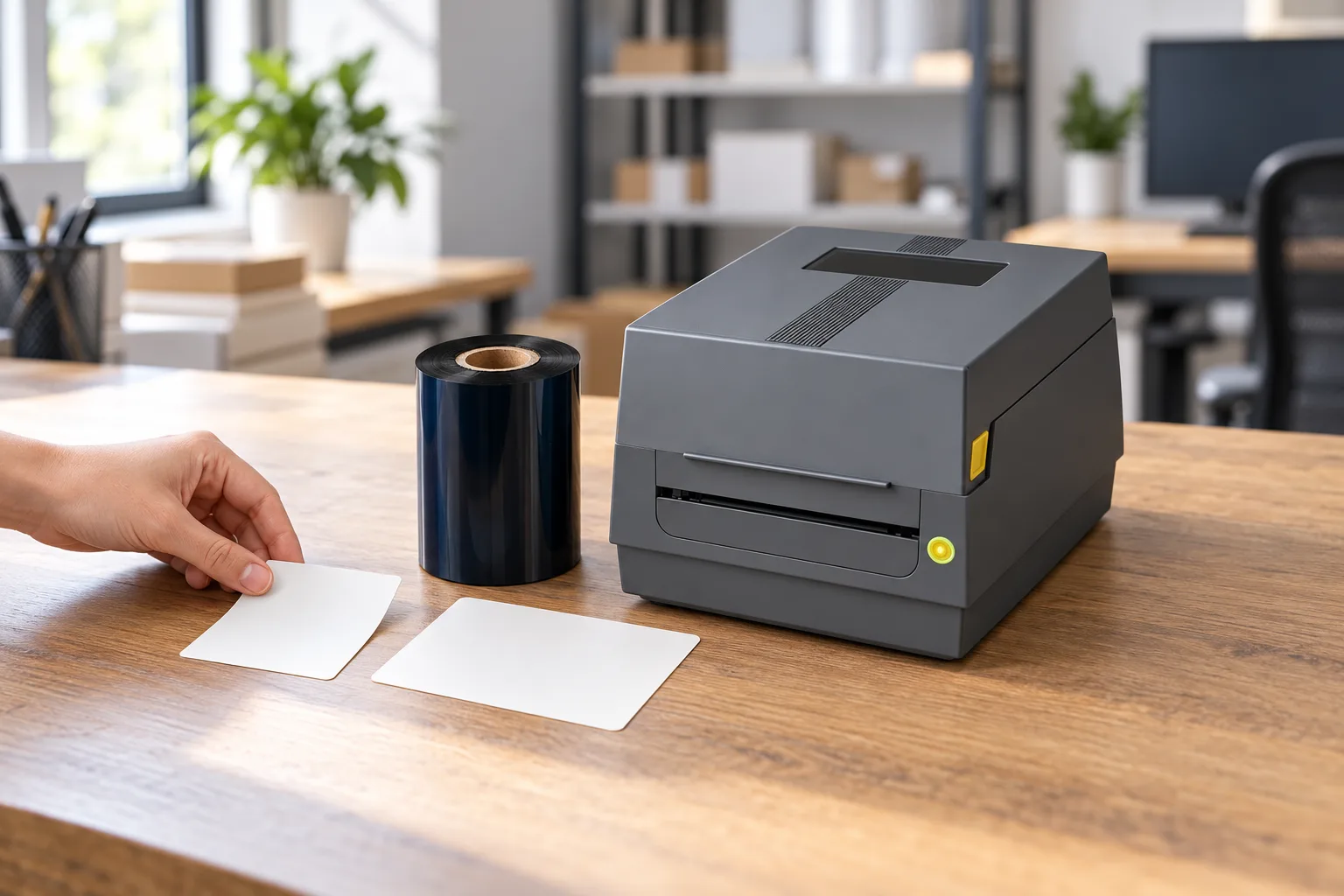
The printing stage happens later in the user’s equipment. Heat and pressure from the printhead transfer the required text or barcode information onto the label. This distinction matters when discussing a project: a ribbon specification describes the consumable used to print, while the label material describes the surface receiving that print.
Manufacturing and printing therefore answer different questions. Manufacturing asks how the ink-bearing film and finished roll are made and controlled. Application validation asks whether that ribbon prints the required information on your material with your equipment and settings. A factory description can explain the first question without settling the second.
Direct thermal is a separate printing method: the JT and Q printer compatibility information describes it as using direct thermal paper without ribbon. Before investigating a replacement TTR roll, establish whether the job actually uses thermal transfer. The general description “thermal printer” alone leaves that distinction unresolved.

Separate coating from finished-roll conversion
COLORFULTTR’s production information describes a manufacturing chain from raw-material formulation and development through coating, slitting and printing checks. Coating creates the ink-bearing ribbon material; slitting and rewinding turn it into the widths and rolls used in printers. Ask which stages a supplier performs when interpreting a claim to manufacture ribbon.
The distinction explains why two separate sets of controls matter. One concerns the coated material and its printing behavior. The other concerns the physical roll, including cutting consistency and winding. Confirming that a supplier can cut a requested width does not, by itself, answer which formulation or coating construction the roll contains.
The production information identifies concrete risks during conversion. Excessive tension can stretch or damage the PET base film and change the ink layer, potentially causing shedding and contamination. Insufficient tension can produce wrinkles, white lines or impressions, and may allow core movement or sideways slipping during transport or installation.
Rewinding also requires a flat roll aligned with its core. Uneven force can contribute to breakage, wrinkles, white lines and impressions; dust contamination can cause white print defects. These are documented possible effects, not a diagnosis for every defective print. Use them to frame questions about production controls and examine the actual roll before assigning a cause.
Distinguish formulation, printer architecture and roll fit
A ribbon choice depends on its formulation, the printer architecture, print settings and required durability, as well as the receiving label surface. These are related checks, but they describe different properties. A common size or shared material name does not establish that two rolls will perform alike.
Wax, wax-resin and resin describe formulation families. COLORFULTTR’s product matrix distinguishes these families and also lists wash-care resin products. Treat a family name as a starting point for understanding the intended application, then identify the actual grade. It does not supply a universal print setting or an acceptance result for your label.
TTO adds an equipment distinction. In the supplied compatibility information, TTO near-edge ribbon is a separate line that cannot be used interchangeably with ribbon for the JT and Q flat-head printers. Consequently, “thermal transfer” is too broad a description for establishing that a packaging-coder ribbon suits a barcode label printer.
Finished-roll fit is another check. Match formulation, ribbon width, core size and roll length to the printer and label material. Record the required ink-side orientation too: COLORFULTTR’s specification list includes both ink-side-in and ink-side-out winding. When comparing replacements, keep the printer-specific requirements together instead of treating one matching dimension as approval of the complete roll.
Read manufacturer identity without assuming performance
Shenzhen Colorfulttr Technology Co., Ltd. describes itself as a thermal transfer ribbon development, production and sales business headquartered in Shenzhen. Its company profile lists a chain covering raw materials, coating, slitting and finished products, together with customization of color, width, length and packaging and OEM/ODM production.
Those statements describe business scope and available customization. They do not establish that any proposed custom roll has already passed your application checks. Likewise, the supplier’s location answers where the company is based; it does not identify the ink grade, winding requirement or performance of a particular shipment.
Private-label packaging needs the same distinction. The production information lists neutral, branded, blank and customer-specific packaging options. A packaging appearance is therefore an incomplete basis for identifying the ribbon inside. For a supplier comparison, request the actual product identification and roll specification alongside the packaging description.
Keep capability evidence and application evidence separate in your records. Use the company profile to understand manufacturing scope and the relevant product information to identify the candidate consumable. Then record a trial on your own printer and production stock. This gives a technical team a clearer basis for evaluating a change than a broad claim such as “manufacturer quality” without a defined ribbon and printing job.
Data and Evidence
COLORFULTTR’s production information identifies print density, clarity, resistance properties, backcoating, tension, flatness and dimensional stability as quality-control priorities. These are areas to check, rather than published acceptance limits for every application. Use the following evidence map to connect a manufacturing statement with the question it can answer.
| Evidence | What it establishes | What to verify next |
|---|---|---|
| Film and coating description | Ink-bearing film with a lubricated reverse side | The candidate grade and intended receiving material |
| Slitting and winding controls | Control of cut width, tension and roll flatness | The finished roll against the printer’s requirements |
| Printer architecture information | The supplied TTO near-edge line differs from JT/Q flat-head use | The exact equipment and ribbon designation |
| Company profile and packaging options | Declared production scope and customization options | Product identity independent of the outer packaging |
The manufacturing descriptions above come from 生产工艺与品质-2025 and 公司简介-2025. Winding options are listed in 公司现行数字系型号规格清单; the equipment distinction follows 公司打印机介质兼容性与材质规格(已审第一方来源).
For the next technical review, document the printer model, ribbon grade, roll configuration, production stock and trial settings on one comparison sheet. Validate the proposed combination on that printer and stock before release. If it falls short, retain the output and recorded conditions, then identify which specification or performance question remains unresolved before approving the change.
Frequently Asked Questions
Does TTR ribbon manufacturing include printing my finished labels?
TTR manufacturing makes the ribbon consumable. In thermal transfer printing, your printer subsequently transfers information from that ribbon onto the label using heat and pressure.
Can I use a TTO near-edge ribbon in a JT or Q barcode printer?
The supplied JT and Q compatibility information excludes the TTO near-edge ribbon line from these flat-head printers. Confirm the exact printer architecture before considering a replacement.
Does OEM packaging prove that two thermal transfer ribbons are equivalent?
Packaging alone does not establish the formulation, roll configuration or application performance. Identify the actual grade and verify the proposed ribbon on your printer, production stock and settings.
Related Products & Guides
Recommended products for this industry
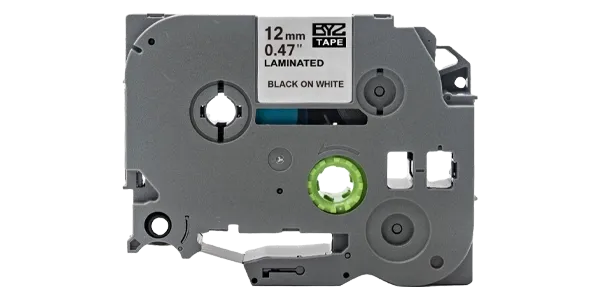
Brother Compatible Label Ribbons (TZe Series)
This Brother-compatible label ribbon (TZe series) is manufactured using high-quality…
View details
Full-colour card printer ribbon YMCKO
Compatible with Seaory S20/S21/S22/S22K card printers, supporting high-definition…
View details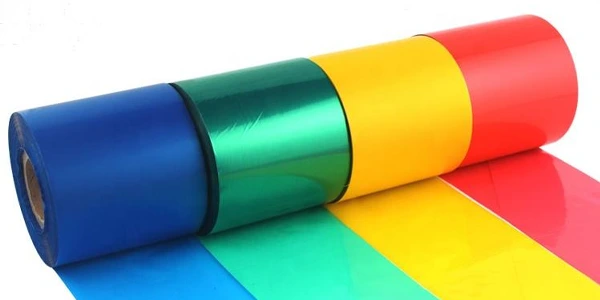
Silver Thermal Transfer Colour Washable Resin Printer Ribbon
High-performance silver thermal transfer washable resin ribbon, specifically designed for…
View details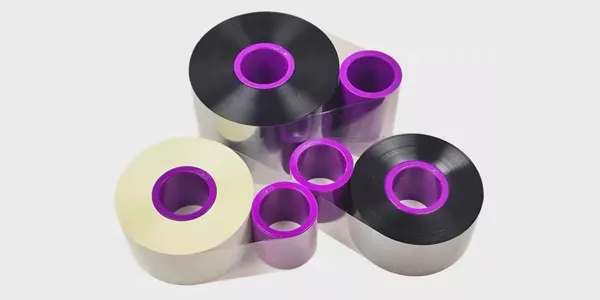
TTO Barcode Printer Thermal Transfer Colour Ribbon High-Speed Customisation
This TTO thermal transfer ribbon is suitable for a variety of label materials across…
View detailsNeed the right ribbon for your label application?
Share the label material, printer and operating environment. Our team will recommend a tested combination.
