
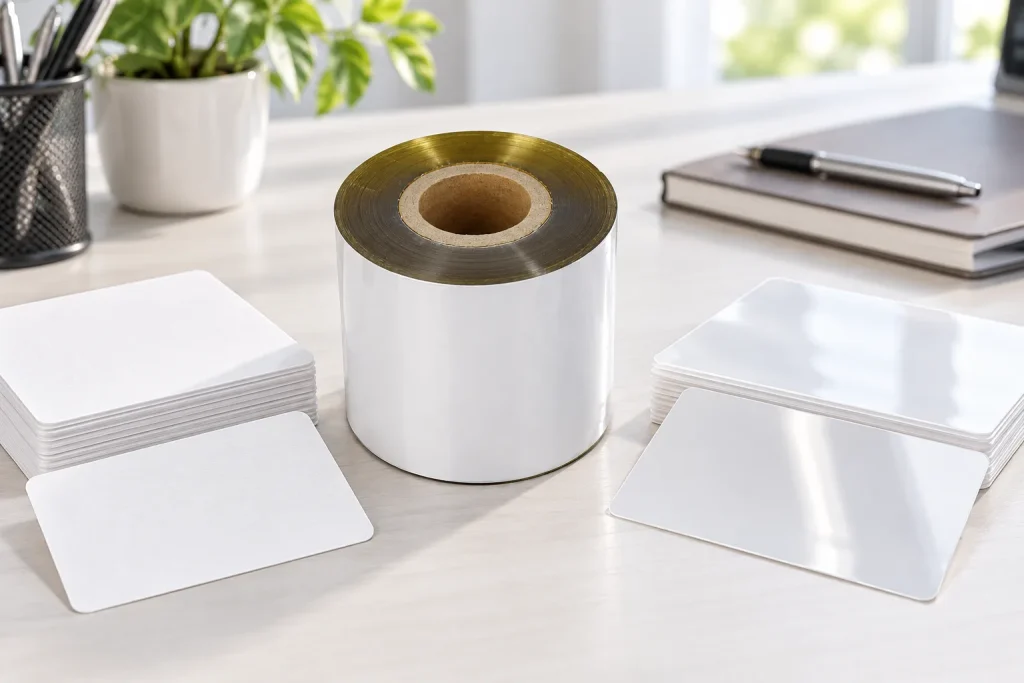
- Original TTR manufacturer since 2013
- Automated coating and slitting
- IQC / IPQC / OQC control
- ANSI barcode grade testing
- -20°C to 120°C environmental testing
- Batch-level traceability
- ANSI barcode grade
- Batch traceability
- RoHS / REACH compliance
- SGS and MSDS documents on request
For label buyers and print teams, wax/resin colour ribbons combine a blended ink family with a specified colour. The blend offers greater durability than wax, while coated paper and selected synthetics are common application areas. Neither the colour name nor the formulation alone establishes printer compatibility or finished-label performance; verify the exact grade with the intended stock and printer.
Key Takeaways
- Wax/resin identifies an ink blend, while colour identifies a separate characteristic of the ribbon.
- Wax/resin ribbons generally serve coated paper and selected synthetic materials.
- The same colour can occur in wax, wax/resin and resin product families.
- Ribbon performance must be validated with the actual label stock, printer and settings.

What wax/resin colour ribbons actually describe
Wax/resin colour ribbons use a blend of wax and resin in the ink layer, with the colour specified separately. The slash describes the blended formulation; it does not mean that the operator combines a wax roll and a resin roll. For a buyer reading a specification, the useful interpretation is therefore two-part: what ink family is this, and which colour grade is being offered?
A thermal transfer ribbon consists of a thin film coated on one side with wax-based, resin-based or blended ink. This separates the ribbon's carrier film from its ink formulation. A reference to a polyester carrier does not, by itself, say that the ink is full resin or that the ribbon has been qualified to print on a polyester label.
Colour adds another distinction. COLORFULTTR's coloured ribbon range is listed as single-colour rolls, rather than a statement that each roll prints the whole colour range. Its product matrix also distinguishes shades and finishes within a colour, including bright and matte gold. When discussing a replacement, retain the formulation and exact colour grade together rather than shortening the description to “colour ribbon”.
This vocabulary helps explain the term before choosing a product. “Wax/resin” answers a formulation question, “gold” or “white” answers a colour question, and the grade identifies the particular product to evaluate. None of these descriptions supplies all the information needed to approve a printed label.

How the blend differs from wax and full resin
Wax/resin ribbons offer enhanced durability compared with wax ribbons, and they are commonly used on coated paper and selected synthetics. This is a useful family-level distinction when interpreting a catalogue. It is not a measured durability result for every coloured grade on every label surface.
Wax ribbons are generally associated with porous and coated paper, while full resin ribbons are associated with more demanding synthetic films such as polyester, polyimide and vinyl. These application groups help narrow the discussion. They do not create a rule that every paper label requires wax or that every synthetic label requires full resin.
The label surface, also called the facestock, is the starting point. The final choice also depends on the ribbon formulation, printer architecture, print settings and required durability. For example, a specification that says only “synthetic label” leaves the actual material and surface undefined. Ask for those details before treating a wax/resin recommendation as an approved combination.
The practical distinction is between an application category and a verified result. Use the category to decide which formulation deserves evaluation, then judge the printed combination against the job's requirements. If the job needs a particular resistance property, keep that property explicit in the specification rather than assuming that the words “wax/resin” supply a universal pass level.
Why colour names do not establish compatibility
COLORFULTTR lists gold ribbons in wax, wax/resin and resin families, so a colour name does not identify one formulation. Its matrix places CL900GD in wax, CL905GD and CL915GD in wax/resin, and CL506GD and CL508GD in resin. These examples explain the naming distinction; they are not interchangeable recommendations for one label job.
The same matrix lists CL600W as an ordinary white wax/resin grade and CL905W as a special white wax/resin grade aimed at matte film. That difference matters when a supplier offers “white wax/resin” as a replacement description. Confirm the exact grade and intended surface instead of accepting the shared colour and family as the full specification.
Printer compatibility is another separate question. The supplied printer compatibility reference classifies coloured ribbons according to their wax, wax/resin or resin formulation. It also distinguishes TTO near-edge ribbons from flat-head printer ribbons. A familiar formulation name therefore does not remove the need to check the printer architecture.
When comparing an existing roll with a proposed replacement, ask for the colour grade, formulation, intended label surface and printer format as separate entries. Include roll width, length, core and ink-side orientation in that comparison. These are specification checks, not evidence that the printed image has already met the application's durability requirements.
Data and Evidence
The supplied product matrix supports qualitative formulation and colour distinctions, while the supplied TDS overview covers named black ribbon grades. Keep those evidence scopes separate: a black grade's published values do not establish the performance of an untested coloured counterpart.
| Question | Supported information | What to verify for the job |
|---|---|---|
| What does wax/resin mean? | A wax-and-resin ink blend with greater durability than wax. | The exact grade and required printed result. |
| Which surfaces are typical? | Coated paper and selected synthetics. | The production label stock and its surface. |
| Does gold identify the formulation? | The product matrix lists gold in wax, wax/resin and resin families. | The colour grade, finish and formulation together. |
| Do the available TDS values cover colour grades? | The supplied TDS overview identifies its five grades as black. | Evidence for the actual coloured grade being proposed. |
Source basis: 公司现行产品矩阵(2026-10-02校订) provides the named colour examples; 公司现行数字系型号规格清单 identifies single-colour rolls; 公司碳带TDS与原始规格入口 defines the black-grade TDS scope. General formulation and surface distinctions follow the supplied verified ribbon descriptions.
To turn these distinctions into a useful next step, prepare a comparison sheet for the current and proposed rolls. Record the exact label stock, printer, settings, ribbon grade and roll format. Print the proposed combination on the production stock and assess it against the job's agreed image and durability requirements. Keep the result with that combination so a later colour, stock or supplier change is evaluated explicitly.
Frequently Asked Questions
Does wax/resin mean two separate ribbons for colour printing?
Wax/resin describes a blended ink formulation, rather than two rolls used together. Colour describes a separate product attribute; confirm both the formulation and the colour grade.
Can I use any coloured wax/resin ribbon on coated paper?
Coated paper is a common application for wax/resin ribbons, but the exact formulation, printer and settings still matter. Validate the proposed grade on your production label stock.
Does a gold ribbon always use a wax/resin formulation?
No. COLORFULTTR lists gold grades in wax, wax/resin and resin families. Match the exact grade and finish rather than treating gold as a formulation.
Can black ribbon TDS values establish a coloured ribbon's performance?
The supplied COLORFULTTR TDS overview covers black ribbons. Use it for the named black grades; request evidence for the actual coloured grade instead of transferring those values.
Recommended products for this industry
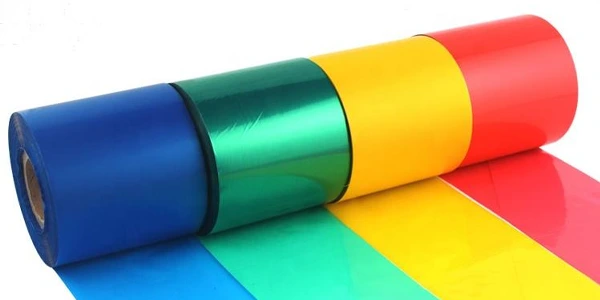
Silver Thermal Transfer Colour Washable Resin Printer Ribbon
High-performance silver thermal transfer washable resin ribbon, specifically designed for…
View details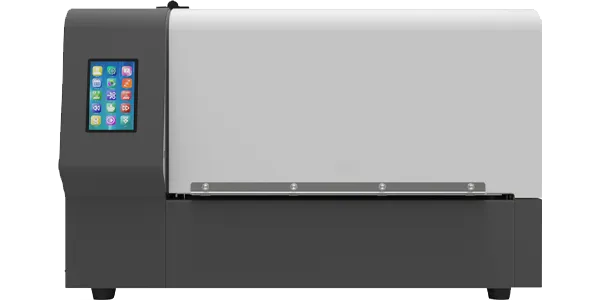
AL10-D Dual-Colour Label Printer
It can enhance industry productivity, optimise supply chain management, reduce…
View details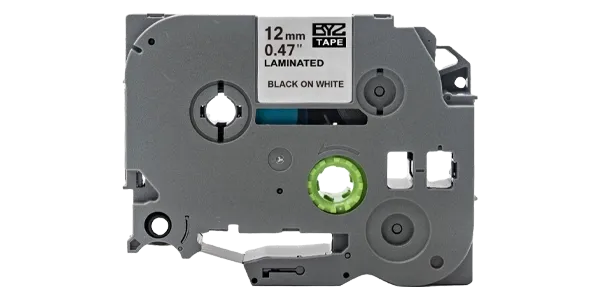
Brother Compatible Label Ribbons (TZe Series)
This Brother-compatible label ribbon (TZe series) is manufactured using high-quality…
View details
CL-Z213 Near-Edge Wax-Resin Thermal Transfer Ribbon for Barcode Labels
An enhanced black near-edge wax-resin thermal transfer ribbon for near-edge barcode printers and low- to medium-speed thermal transfer overprinting (TTO). Listed applications include retail labels, warehousing, garment tags and packaging identification. Match the printer, actual print medium and operating speed before selection: print quality and image durability can vary with the printer and substrate.
View detailsNeed the right ribbon for your label application?
Share the label material, printer and operating environment. Our team will recommend a tested combination.
