
Industrieetiketten Drucken: What Industrial Label Printing Means and Where Its Limits Sit
Request a solution
- Original TTR manufacturer since 2013
- Automated coating and slitting
- IQC / IPQC / OQC control
- ANSI barcode grade testing
- -20°C to 120°C environmental testing
- Batch-level traceability
- ANSI barcode grade
- Batch traceability
- RoHS / REACH compliance
- SGS and MSDS documents on request
This explainer defines Industrieetiketten drucken — printing industrial labels — for B2B buyers and print-shop technical leads who must match ribbons, label materials, and printers. It covers what thermal transfer printing is, how it differs from neighboring concepts, where printed durability comes from, and what catalog values and test results cannot prove. Every key figure and test condition is consolidated in the Data and Evidence section, so each claim can be checked before you specify a ribbon or judge a print defect.
Key Takeaways
- Printing industrial labels by thermal transfer means a barcode printer's print head uses heat and pressure to move text and barcode information from a ribbon onto the label.
- A thermal transfer ribbon (TTR) is a polyester base film carrying an ink layer of wax, resin, or a wax-resin blend, plus a back coating that protects the print head.
- Ribbons are customized in width, length, color, and packaging, so ribbon-to-printer fit is specified per machine instead of assumed.
- Print quality also depends on production and handling: slitting tension, dust control, and storage at -5°C to 40°C and 20%–85% relative humidity for no more than one year.
- Documented tests — seawater immersion up to three months, sand-and-salt abrasion, and adhesion on various container materials — describe tested conditions, not a promise for every label batch.
What Industrieetiketten Drucken Means as a Process
Industrieetiketten drucken — printing industrial labels — is the process in which a barcode printer's print head applies heat and pressure to transfer text and barcode information from a thermal transfer ribbon onto a label. The ribbon is the consumable that carries the image. Its base film is a thin, durable layer of polyester or another high-density material, its ink layer is made of wax, resin, or a wax-resin blend, and its reverse side carries a lubricating coating that protects the print head during printing.
Ribbons printed in this way serve packaging, electronics, automotive parts, jewelry, apparel and footwear, logistics, pharmaceutical, and food applications — the fields most buyers picture when they search for industrial labels. The definition matters for daily work because the ribbon is a matched consumable: its width, length, and ink chemistry belong to a specific printer and label task, and treating it as a generic commodity is where compatibility problems usually start.
How Thermal Transfer Differs from Neighboring Label-Printing Concepts
Industrial label printing in the thermal transfer sense always consumes a ribbon: heat and pressure move ink from the ribbon to the label, so any marking method that transfers no ink from a ribbon is a different technology, and the evidence in this article does not cover it. In practice, the same search phrase also describes ordering labels that a converter prints for you; this article deals with printing them yourself on a barcode printer, because that is where ribbon grades, printer fit, and print defects actually sit.
Within in-house thermal transfer printing, three variables separate one setup from the next:
- Ribbon chemistry. Ranges run from wax and wax-resin to resin, plus special grades such as wash-off resin, TTO, and card ribbons. Every grade prints through the same heat-and-pressure mechanism, so the grade changes the ink formulation, not the process.
- Ribbon format. Color, width, length, and packaging are customized to the customer's requirement, which is why a ribbon specification belongs to a particular printer rather than to a generic shelf product.
- Consumable condition. How the ribbon was slit, shipped, and stored decides much of the print result — the next section breaks this down.
Where Printed Durability Comes From
Printed durability starts in ribbon production, because the base film, the ink layer, and the precision of slitting together decide whether the printed image stays clean on the label. A specialist manufacturer coats the polyester film with ink on one side and the protective back coating on the other, then slits the mother roll to the customer's width. Shenzhen Colorfulttr Technology Co., Ltd., founded on January 22, 2013, runs this chain from raw materials through coating and slitting to finished rolls, and emphasizes print clarity, abrasion durability, and anti-static back-coating technology.
Slitting and handling errors leave traceable defects, and the documented causes and effects are:
| Documented cause | Documented effect on ribbon or print |
|---|---|
| Slitting tension too high | PET base film stretches and is damaged, the ink layer changes physically, and the ribbon may shed powder and contaminate the machine |
| Slitting tension too low | Wrinkles, white lines, and press marks; the core may shift or slip during transport or installation |
| Dust contamination in slitting | White-dot defects in the printed image |
Handling after production sets further boundaries. The documented use environment is 5°C to 35°C at 45%–85% relative humidity. Storage runs from -5°C to 40°C at 20%–85% relative humidity for no more than one year, and transport shares that window with a one-month limit. Ribbons must also stay out of direct sunlight and damp conditions, or print quality suffers.
What Specs and Test Results Cannot Tell You
A documented test result or a catalog value describes the item and the condition it was measured on; it does not by itself qualify every printer setting, label material, or delivery batch. Three limits matter in daily work.
- Test records are scoped, not universal. Verified records document seawater immersion for up to three months, abrasion testing with sand and salt exposure, and adhesion testing on various container materials. They evidence what was tested under its own conditions — not a blanket rating for every industrial label in every environment.
- Catalog values are neither settings nor acceptance standards. A recommended value cannot serve as the universal setup for every printer or as the acceptance line for a whole batch; tune per machine and confirm each delivery with a sample print.
- A print defect has more than one possible source. White lines, wrinkles, powder shedding, and white dots all appear in the production and handling record above, so the consumable itself can be the cause while the printer stays correctly set.
When a print fails, work the causes in this order:
- Check the ribbon lot's age and its storage record against the documented windows.
- Inspect the roll for wrinkles, white lines, or powder before loading it.
- Print a sample and note where in the image the defect appears.
- Only then adjust printer settings, and ask the supplier for the test and production scope behind any figure you relied on.
Data and Evidence
The table below consolidates the documented values and test records used in this article, each tied to its condition. The production figures come from the manufacturer's company and production-quality references (公司简介-2025, 生产工艺与品质-2025); the construction and test items come from verified records.
| Item | Documented value or condition | Source |
|---|---|---|
| Ribbon construction | Polyester film; wax, resin, or blended ink on one side; lubricating material protecting the print head on the other | 生产工艺与品质-2025 |
| Base film | Thin, durable polyester or other high-density material | verified ribbon-construction record |
| Ink layer | Wax, resin, or a wax-resin blend | verified ribbon-construction record |
| Ribbon range | Wax, wax-resin, resin, wash-off resin, TTO, card ribbons | 公司简介-2025 |
| Use environment | 5°C–35°C, 45%–85% relative humidity | 生产工艺与品质-2025 |
| Storage | -5°C–40°C, 20%–85% relative humidity, up to one year | 生产工艺与品质-2025 |
| Transport | -5°C–40°C, 20%–85% relative humidity, up to one month | 生产工艺与品质-2025 |
| Immersion test | Seawater immersion for up to three months | verified test record |
| Abrasion test | Sand and salt exposure | verified test record |
| Adhesion test | Various container materials | verified test record |
To verify any figure: ask your supplier for the scope behind the test record, request the production and storage data of the ribbon lot you received, and run a sample print on your own printer and label before volume work. That single check catches most mismatches between a documented value and your actual result.
Frequently Asked Questions
Which ribbon grade should I use to print durable industrial labels?
Grades differ by ink chemistry — wax, wax-resin, and resin, plus special ranges such as wash-off resin, TTO, and card ribbons — and all of them print through the same heat-and-pressure mechanism. Match the grade to your label material and durability requirement, then confirm with a sample print instead of assuming the grade name alone secures the result.
Why do my printed industrial labels show white lines or white dots?
Documented production causes include slitting tension set too high or too low (powder shedding, wrinkles, white lines, press marks) and dust contamination in slitting (white-dot defects). Storage outside -5°C to 40°C and 20%–85% relative humidity, or exposure to sunlight and damp, also degrades print quality. Check the ribbon's condition and storage record before changing printer settings.
How long can thermal transfer ribbons be stored before printing?
The documented storage window is -5°C to 40°C at 20%–85% relative humidity for no more than one year, away from direct sunlight and moisture. Transport is documented at the same temperature and humidity for up to one month.
Does a three-month seawater immersion result apply to every label batch?
No. The record documents seawater immersion for up to three months under tested conditions; it is not a universal rating for every printer, label material, or delivery. Request the test scope from your supplier and verify with your own sample print.
Related Products & Guides
Recommended products for this industry

Acid and Alkali Resistant Label
Chemical-resistant label construction for acid baths, paint-stripping solutions, alkali…
View details
Aluminum Foil High-Temperature Label
Coated aluminum label for metal processing, heat treatment and high-temperature part…
View details
Anti-Static High-Temperature Polyimide Label
Anti-static polyimide label for ESD-sensitive electronics assembly and high-temperature…
View details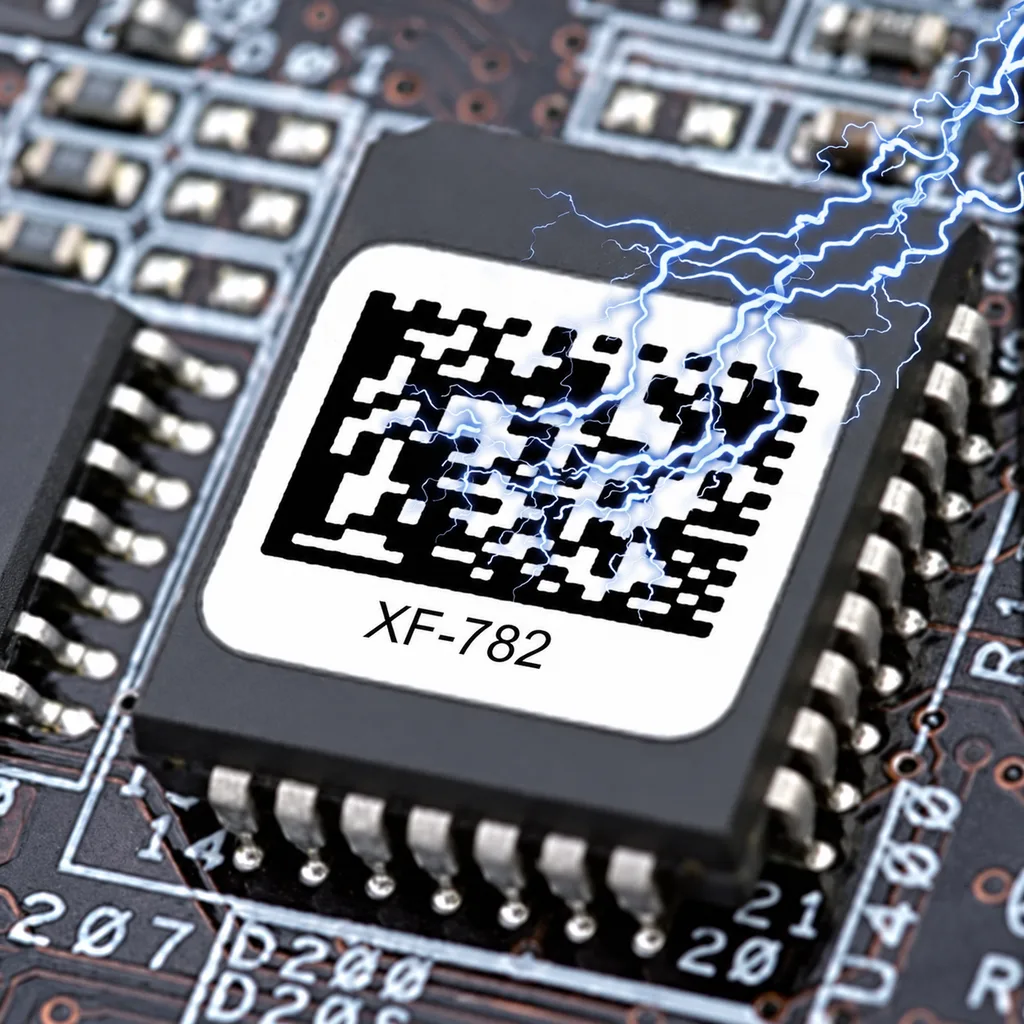
Antistatic Polyimide Labels for PCB Process Tracking — CL-782
CL-782 is a white gloss polyimide (PI) label material for printed circuit board (PCB) and sensitive-component process control and product traceability in electronics manufacturing. It is described for wave soldering and reflow soldering applications, with a listed temperature range of -40-300℃, an antistatic value of ≥10^(8)Ω and ≤10^(11)Ω, and a peel voltage below 100 volts. Selection should account for the actual thermal cycle and chemical exposure; the supplied information does not specify exposure durations or chemical test conditions.
View detailsNeed the right ribbon for your label application?
Share the label material, printer and operating environment. Our team will recommend a tested combination.
